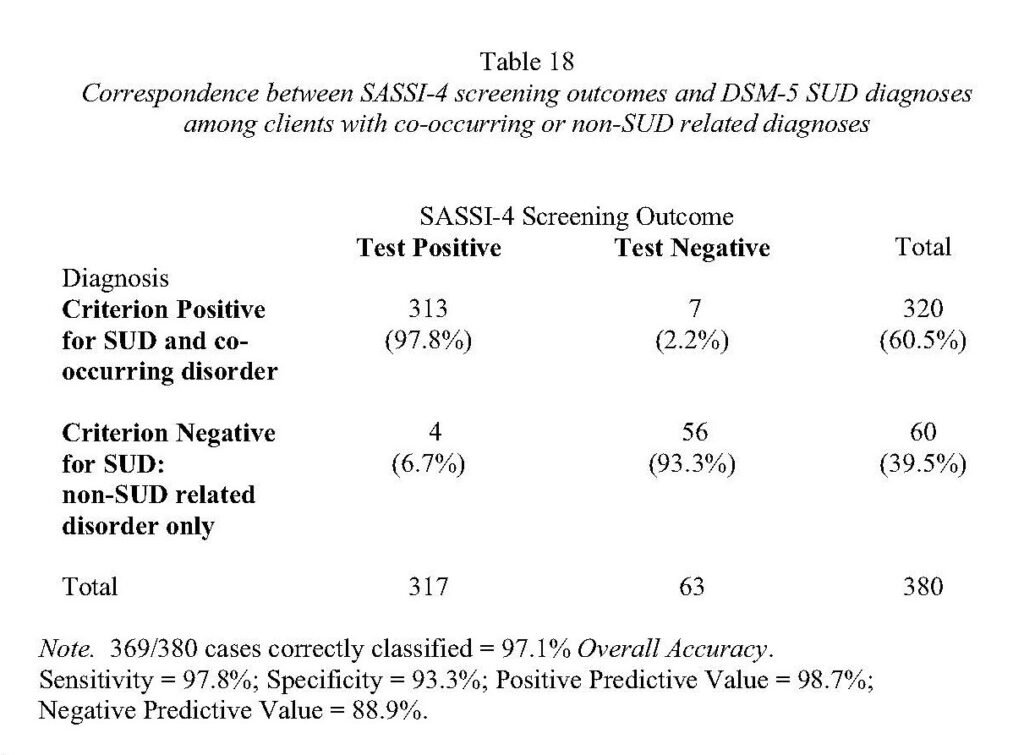
This very unusual profile was called in to our Clinical Helpline Staff and provides us the opportunity to discuss several key issues with regard to clinical interpretation of individual SASSI scale raw scores:
- It is critical to gather additional information beyond the SASSI from reliable sources and then integrate this information with the basic foundational scale interpretations provided by our case study research;
- When highly unusual scale scores occur, seemingly contradicting one another, resist the temptation to over-interpret and;
- Notice when scale score interpretations suggest potential problem areas beyond just the substance use disorder issues and make a plan to address these.
This client profile is a clear example of the need for additional clarifying information about the client. The only information we were given was the client’s biological sex (female) and their age (25 years old). What makes this profile confusing is that the individual scale scores sharply deviate from “normal” scoring patterns in a few places, which leads to scale interpretations that seem to contradict one another. For example, the client has clearly acknowledged that she has had or is having significant negative consequences, problems or trouble as a result of her use of both alcohol and other drugs (FVA=23 and FVOD=30) and therefore may have lost control of her use and may be using as a coping mechanism. These scores are extremely high compared to the general population and typically leave no doubt that this person has most certainly crossed the line into substance addiction and is quite willing and able to recognize and admit the severe consequences her substance mis-use has caused in her life. This is further confirmed by an extremely high OAT scale score of 8 which would generally be interpreted to mean that this person greatly identifies with many of the usual negative attributes or personal limitations/weaknesses that are common among those with active substance use disorders (e.g. impatience, resentment, self-pity, impulsiveness, restlessness) and usually, if asked, would readily admit to sharing many similarities with those who have substance problems. Lastly, her SAT scale score is also extremely high, once again strongly indicating a person with a significant substance problem.
But there are other scale scores which seem to contradict some of these basic interpretations. For example, the client has a DEF score of 11 which is far above the 98th percentile and suggests that the client is answering the questions in such a way on this scale that would indicate someone who would tend to not share anything about herself that would put them in a bad light or show weakness or vulnerability. DEF scores like this usually tend to suggest a client who wants to appear as if they have it altogether as they are endorsing only positives about themselves. How can this be true though if their FVA/FVOD and OAT scale scores are so high that they strongly indicate a person who is able to admit and acknowledge numerous negative consequences from substance mis-use and is able to strongly identify with many of the same negative attributes or weaknesses that are often found in those with active substance disorders? In addition to that, how can this client have such extremely high scores on FVA and FVOD and yet have a relatively normal score of 4 on the SYM scale? The SYM scale, like the FVA/FVOD scales, is also a very obvious, face valid set of questions about problems with substance use and yet her score on the SYM seems to indicate relatively none of the typical symptoms we would associate with one struggling with a SUD. One possible reason for the discrepancy between the scores on the FVA/FVOD scales and those on the SYM scale would be because of the timeframe that the client was asked to use in answering the FVA/FVOD scale questions. Unfortunately, we were not given this information about this client profile, but if the client was asked to answer the FVA/FVOD questions based on their entire life, then the scores could be quite high but be representative of a time in the distant past. Since the T/F questions have no specific timeframe associated with them, the client may have answered the SYM questions based on a more recent timeframe in which they had achieved some level of sobriety.
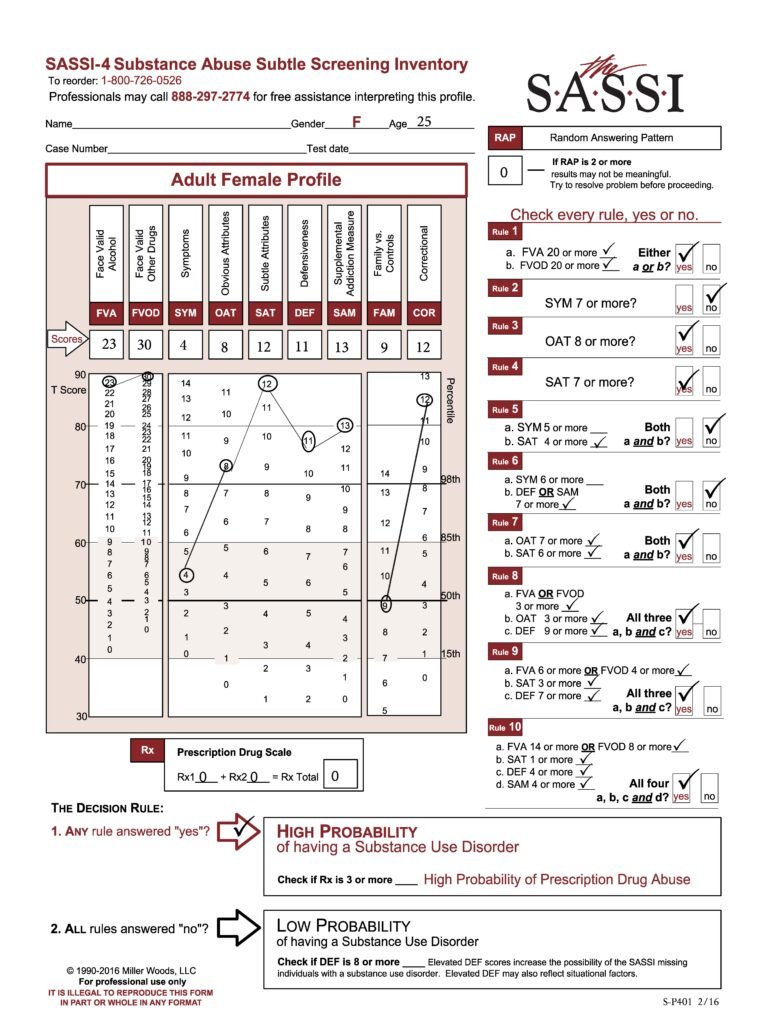
Even the extremely high SAT score seems a bit contradictory with other scale scores since usually a high SAT score would indicate someone who is not able to admit or acknowledge that they have a substance problem. However, since the SAT score was positioned higher on the graph then the OAT scale score, our research suggests that individuals with that type of scoring pattern are sometimes able to admit to the very obvious consequences of their substance misuse (when OAT and Face Valid scale scores are high like this client) and may even be able at times to self-identify to a certain extent with certain obvious behavior patterns that often lead to substance misuse. However, people with very high SAT scores, and especially ones that are higher on the graph then the OAT score, are often not able to see the deeper, underlying, less conscious issues that are constantly plaguing them and significantly influencing their substance misuse behaviors in a much more covert way. They often simply cannot see the pervasive nature of the disease acting in their everyday life. They often are emotionally avoidant and superficially may believe that their substance problems are just a set of bad habits that they can stop on their own. They see the physical manifestations of the problem, but are unable or unwilling to see the emotional and spiritual aspects of the problem. They often will actively avoid treatment that involves examining their negative thought patterns, deeply held negative beliefs, fears, and other deeply rooted issues that have a stranglehold on their life and behaviors. Some of these clients will incorrectly assume that their substance problems only reside with their use of the “hard” drugs and if they just quit using those, then they can continue to drink and smoke marijuana and all will be well.
This explanation actually helps us to better interpret the client’s very high DEF score as well. While the client is able to admit and acknowledge having a lot of problems and trouble as a result of her use of alcohol and other drugs as seen in her very high FVA, FVOD, and OAT scores, her very high SAT and DEF scores show that her admission and acknowledgement is only at a very surface level. In other words, she admits all the things that are pretty much already part of the public record and everyone knows about, but the problem is much deeper than that and she is oblivious to how deep and pervasive it really is. This is what we would call a sincere delusion. She admits what she is aware of and what she feels she has control over. But there is much more beneath the surface that she can’t see. Her defensiveness is potentially a way for her to demonstrate that she’s in control, that there’s nothing to see here and everyone should move on. Like her very high SAT score implies, she may be unable to identify or get in touch with her real emotions and pain and she may have situational reasons or life experiences which have taught her to not let people see her flaws or weaknesses, the real her. She will tend to focus away from internal processes and look instead at tasks and factors outside of herself. This increases the likelihood that she may put herself at risk without awareness of her own vulnerability. She will be more likely to find excuses not to engage in treatment and recovery activities, especially if she is able to achieve short spurts of sobriety. Once the challenge of proving she can abstain from alcohol or drugs for a short time loses its luster or crises arise that she cannot cope with on the basis of her more superficial focus, she will be more likely to relapse.
The risk of relapse is particularly increased given her similarity to others who violate cultural norms sufficiently to have repeated involvement with the criminal justice system, as evidenced by her elevated COR scale score (COR=12). In addition, the elevated COR score suggests increased risk for future criminal behavior independent of the client’s substance use or mis-use. A comprehensive assessment of underlying risk factors in the client such as poor social skills, anger management issues, poor impulse control or low frustration tolerance would be a valuable exercise so that, if any of these issues are uncovered, an effective treatment plan that specifically addresses these issues could be developed to potentially decrease the risk of repeated involvement with the criminal justice system.
In summary, this young woman’s profile indicates three problem areas that need to be the focus of potential treatment: her substance use disorder (if diagnosed), her defensiveness, and her risk for legal problems. This client meets SASSI Decision Rules indicating a high probability of a substance use disorder. While the SASSI does not specifically provide a prediction of the level of the disorder (i.e. mild, moderate or severe), typically clients with FVA/FVOD, OAT and SAT scores as high as this client’s often have moderate to severe disorders if the disorder is active. The scores also suggest a pattern of addictive behaviors that have a pervasive influence on her life, which she is not likely able to fully recognize or accept. She most likely has little or no self-awareness with regard to her underlying emotional pain and may tend to shift responsibility or blame to her life situation and/or other people.
In light of this, she will most likely resist many conventional forms of treatment and prefer to “fix it” herself. There is a high risk of premature self-labeling as “cured” after one or two successful short attempts at sobriety, ultimately resulting in full blown relapse. The risk of future criminal behavior is high, suggesting that compliance with other rules may also be problematic. Further assessment and/or building in a specific treatment focus on this risk through cognitive-behavioral interventions would be reasonable options to consider.
In trying to interpret the individual scale scores for this client, one can see that, while the foundational interpretations that normally apply to certain scoring patterns certainly can lead us in the right direction, without more data from other reliable sources, one can only speculate as to why some of the standard scale score interpretations initially seem to be in contradiction with one another. With more information from collateral sources (family, teacher, employer, coach, friends, etc.), naturally occurring records (e.g. arrests, ER visits, prior treatments, etc.) or behavioral records (work behavior, school behavior), we could more easily narrow down, shape and confirm or deny our initial interpretations.
Getting additional information from other sources also can help us to resist over-interpreting. In the absence of clear information, one is more likely to speculate. While no SASSI interpretations are ever meant to be considered absolute, we can nevertheless trust that the foundational interpretations which came from our case study research have proven to be quite reliable and accurate in most cases. But when individual scale score interpretations seem to clash, we have to resist making up information and therefore over-interpreting or mis-interpreting and instead gather actual data that could more correctly resolve the perceived conflicts.
And finally, spend time learning and practicing how to utilize the SASSI foundational scale score interpretations in combination with other reliable sources to identify and address any other non-substance-specific challenges facing the client. These could range from defensiveness and high risk of involvement in the criminal justice system like this client to possible depression, suicidal ideation, or typical symptoms associated with co-dependency. While the SASSI’s primary function is not that of a depression, suicide risk or co-dependency screening, basic scale score interpretation can provide clinicians with a “heads up” on the possibility of these and other issues, prompting the clinician to do further evaluation in these areas and develop treatment plans, educational resources and/or referral plans to address them.
To become more familiar with clinical interpretation, we invite you to attend one of our training sessions taught by a SASSI-certified trainer ( https://sassi.com/sassi-training/) and/or to utilize our free Clinical Helpline at 1-888-297-2774 which is available Monday – Friday from 1:00pm – 5:00pm EST to assist clinicians in learning how to interpret their client’s results better.