Tag: Substance Use Disorder Screening Instrument

Have You Been SASSI Trained?!

In my conversations with SASSI users on our free Clinical Helpline, I often run into people who have never participated in an official training led by a SASSI-certified trainer. Some of them have never been trained by anyone and are just trying to figure it out on their own or using the SASSI User Guide & Manual. Others have had a co-worker show them what they know about the instrument, sometimes inadvertently receiving misinformation or information lacking in important details. Thankfully, the SASSI was originally designed to be a simple and easy to use screening instrument that doesn’t necessarily require one to have a specific credential or college degree in order to successfully administer and score the instrument. So, anyone can easily learn to use the SASSI effectively and accurately with proper training.

I remember several years ago I was doing a training on the SASSI for a probation department and one of the attendees, who had been using the SASSI for over 10 years and who wasn’t sure why he had to be at the training, came up to me at the break and told me he had already learned several things in the first 1 ½ hours that he hadn’t known for the past ten years! He had never been to an official SASSI training done by a SASSI certified trainer until that day. For him, he was now glad he had been required to go to the training that day!

While the basics of administering and scoring the instruments are quite simple, the SASSI also has additional utility in the form of Clinical Interpretation of the Sub-Scales that can be used to help us in treatment planning, educating the client, making referrals for clients and just understanding our clients better. Like most things involving humans though, clinical interpretation can be rather complex and not as straight forward as the basics of administration and scoring. Getting good training by a SASSI-certified trainer is a first step to learning to master the interpretation of individual sub-scales on the instruments. The second step after training is to regularly utilize the free Clinical Helpline service offered by the SASSI Institute weekly M-F from 1:00pm-5:00pm EST. Through this service, callers are able to essentially extend their training on the SASSI for free and practice their clinical interpretation with SASSI clinical experts as often as they want or need each week.

So, if you’ve never been to an official SASSI-certified training or it’s been many years ago and you need to go to training again to get a “refresher,” let me encourage you to take that step in improving your knowledge base to get more out of this amazing screening instrument to better assist your clients. You can go to the Training section of the SASSI website by going here: https://sassi.com/sassi-training/. From there, you can click on United States or Canada to see if there are any trainings scheduled by state, province or region by our certified trainers; or you can click “Online” to view and register for any of our upcoming live public webinar trainings which are separated by those that are specifically for the Online/Web-based version of the SASSI and those for the traditional paper/pencil version of the SASSI. On this page you can also register for “On-Demand” recorded SASSI trainings if you don’t want to wait for a live training. The live trainings offer you the advantage of being able to interact in real time with the trainer and other participants and ask any questions you might have on the spot. The “on-demand” recordings offer the convenience of immediate viewing. Choose what works best for you but please consider getting training in an official SASSI-certified session. Who knows? You might find out some things about the SASSI you never knew that can help you use the instruments more effectively.

Reducing Stigma Through Objective Assessment

The Ethics of Standardized Screening

Stigma is perhaps the most significant “silent” barrier in behavioral health. When assessments are based purely on subjective interviews, they are vulnerable to the unconscious biases of the interviewer. These biases can be based on a client’s appearance, socioeconomic status, race, or even their “likability.”

The Role of Objectivity The SASSI Institute was founded on the principle of providing validated, objective data. When we use a standardized screening instrument as part of an assessment, we are providing the client with a fair hearing. The results are based on decades of empirical research and rigorous validation studies, not the “gut feeling” of a provider.

Humanizing the Data Standardization makes our care more human. It ensures that:

  1. Equity: Every client is screened using the same criteria.
  2. Accuracy: Diagnoses are backed by psychometric evidence, which is crucial for insurance authorization and legal standing.
  3. Communication: It provides a common language for the treatment team (doctors, counselors, and social workers) to discuss the client’s needs.

As we look toward the future of the SASSI Network, our goal remains clear: to empower clinicians with tools that see past the stigma and focus on the person’s clinical needs. By relying on evidence-based screening, we aren’t just filling out forms—we are advocating for the dignity of our clients.

Why Looking Beneath the Surface Matters in Screening

The Science of Face Valid vs. Subtle Items

In the world of substance use assessment, there is a recurring challenge: the “Honesty Gap.” When a client enters a screening environment, whether due to a court order, workplace requirement, or personal crisis—they are often operating under extreme pressure. This pressure frequently manifests as denial or purposeful concealment.

The Limitation of Direct Questioning: Most screening tools rely almost exclusively on “face valid” items. These are questions where the intent is obvious, such as “How many times a week do you use stimulants?” While these questions are necessary, they are easily manipulated. A client who is not yet ready to change, or who fears the consequences of their answers, will likely underreport.

The SASSI Advantage: Subtle Scales The SASSI-4 (Subtle Substance Abuse Screening Inventory) is unique because it utilizes subtle items. These are questions that do not appear to be related to substance use on the surface, but are statistically correlated with individuals who have been diagnosed with Substance Use Disorders (SUD).

By integrating these subtle scales, the SASSI provides a “safety net” for the clinician. If a client’s face-valid scores are low but their subtle scores are high, it usually indicates a high probability of a substance use disorder based on the SASSI decision rules despite the client’s current inability or unwillingness to acknowledge it.

Clinical Application This isn’t about “tricking” the client. Instead, it’s about providing the clinician with a more accurate roadmap. Knowing that a client is defensive or in denial allows you to adjust your clinical approach—providing an opportunity for more open dialogue rather than immediate confrontation—thereby increasing the chances of long-term treatment retention.

The Purpose & Potential of Assessment and the Role of SASSI Screening

Engaging in assessment regularly can make it become routine; therefore, sometimes perspective is lost and the purpose forgotten. Time needs to be taken to remember the precise questions assessments are trying to answer. When forgetting the specific reasons for conducting assessments, they lose their value ­ both to the individual client and the clinician.

Screening is an important part of assessment for the purpose of triage, identification of risk factors, and referral for additional services. The basic question is whether an individual is likely to have a particular problem. If so, the subsequent assessment and treatment plan should address that problem. Since screening tools are used to identify people who are likely to have a problem or be at risk for developing a problem, they are never infallible. The key element is to use a screening tool that meets the needs of the clinician. As an example, the crucial factor in airport security screening is that the procedure be highly sensitive; they do not want to miss anyone who is a security risk. ln other words, they do not want any false negatives. However, in eliminating all false negatives, the procedure that is used produces false positives and anyone carrying metal is flagged by the airport security screening and given some degree of further scrutiny, even though most people who carry metal are not found to be a security risk. But different screening settings have different needs. ln developing and maintaining the SASSI, the researchers recognized that there are costs associated with both over and under-identification of substance use disorders (SUD). Therefore, the research and development aims were directed toward maintaining a high level of sensitivity (few false negatives) and a high level of selectivity (few false positives).

While a relatively comprehensive assessment may be needed to arrive at a diagnosis, the basic question is whether the individual meets the specific criteria (e.g., DSM-5) necessary to arrive at a diagnosis. There exists a long-standing controversy regarding the value of diagnoses. Some argue that diagnoses serve to label people unnecessarily and others argue that it is important to do whatever possible to specify an individual’s problem in a reliable and meaningful manner to ensure appropriate treatment recommendations. Regardless, most agencies require clinicians to formulate a diagnosis, and diagnoses are needed for third party payments and as part of the admission criteria for many treatment programs.

Assessments are also needed for reports. Often individuals are referred by outside agencies (e.g., other health service providers, courts, employers, schools). In these instances, the clinician is placed in the position of providing expert opinion in what may be controversial or even litigious situations. It’s vital for the clinician to have a clear understanding of the precise request being made by the referral agency – What are the questions to be answered? What are the issues that are to be addressed? What types of opinions and recommendations are requested?

In conducting the assessment and writing the report, the clinician should be clear in differentiating observations from inferences and opinions. For example, if the only information on frequency and quantity of consumption of alcohol and other drugs is the individual’s self-report, the written report should indicate that the individual reports using a certain amount, not that the individual actually consumes that amount. If the clinician has cause for concern regarding a symptom of SUD, it should be phrased as a cause for concern rather than an observation. When using the SASSI to screen it becomes possible to make a statement to the effect that the individual’s pattern of responses suggests, with a known level of certainty, that the client is or is not likely to have an SUD. (Note: In addition to screening results, supplemental clinical information is required to meet the accepted standards for a DSM-5 clinical diagnosis of an SUD). The SASSI Rx scale can also help identify individuals likely to be abusing prescription medications and the other additional scales can provide clinical insight into level of defensiveness, consequences of use, desire for change, family and social risk factors, and acknowledgement of problems.

Always present information clearly and distinguish observation from inference and opinion. It is important to help the individual become increasingly invested in the treatment process. Assessment is a critical part of the treatment process and provides an opportunity for the clinician and the individual client to mutually identify problems, set goals, and devise strategies to meet those goals. The individual client is the primary focus, and the information that’s gathered is useful to these individuals only to the extent that it helps them take action that enhances their quality of life. For information on interpreting SASSI scales, please consider completing our Clinical Interpretation training. Registration information can be found at https://sassi.com/sassi-training/.  Also, professionals can call our free clinical helpline at 800.726.0526 Option 2, M-F 1-5pm ET for help with profile interpretation.

High Probability by Subtle Scales Only

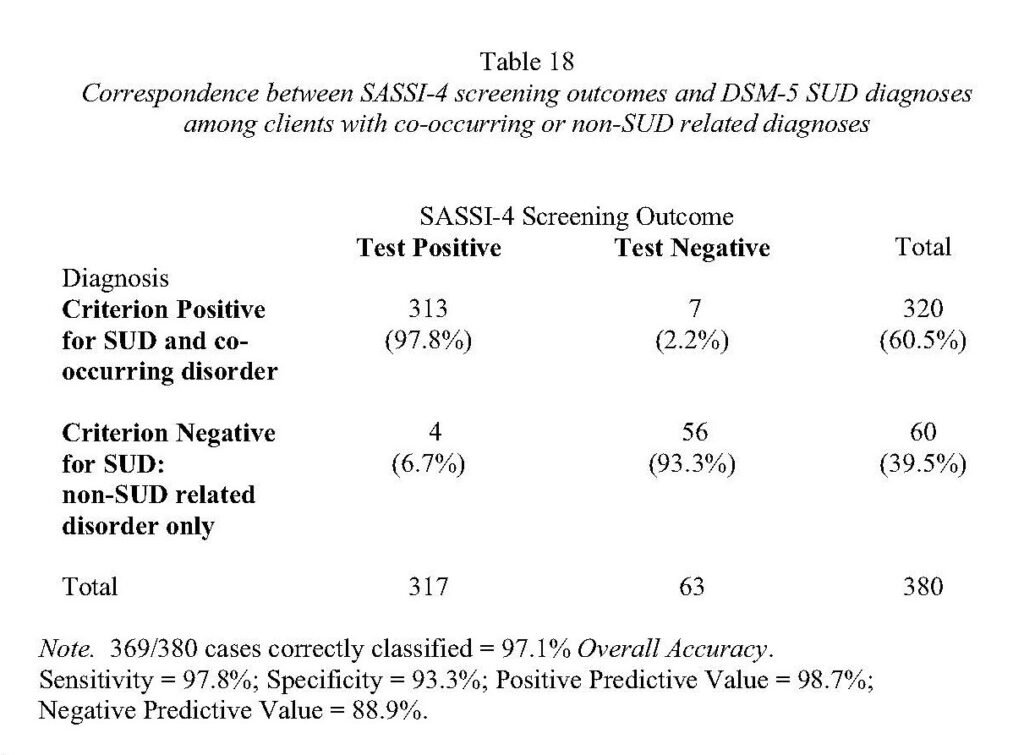
Many people know that the SASSI is possibly the best substance use disorder screening tool that exists in the behavioral health field today. The instrument can be easily administered in 15 minutes or less and manually scored in less than two minutes (or scored automatically in the online web-based version), resulting in an objective empirically-based statement of the likelihood of the client having a substance use disorder with an overall accuracy of 92% for adults and 89% for adolescents. And it achieves this kind of accuracy even in clients who are unwilling or unable to acknowledge their substance misuse or the symptoms associated with it!

Through extensive case study research, the SASSI has been found to be able to provide even more utility to clinicians in the form of clinical interpretations that go beyond just the high or low probability of a substance use disorder result. In addition to interpretations of individual scale raw scores that fall outside the boundaries of the research-based established normal distribution, we also have discovered some trends or characteristics in the specific situation in which the client scores as high probability of a substance use disorder based on SASSI decision rules that involve only subtle scales rather than face valid scales. That is the subject of our blog today.

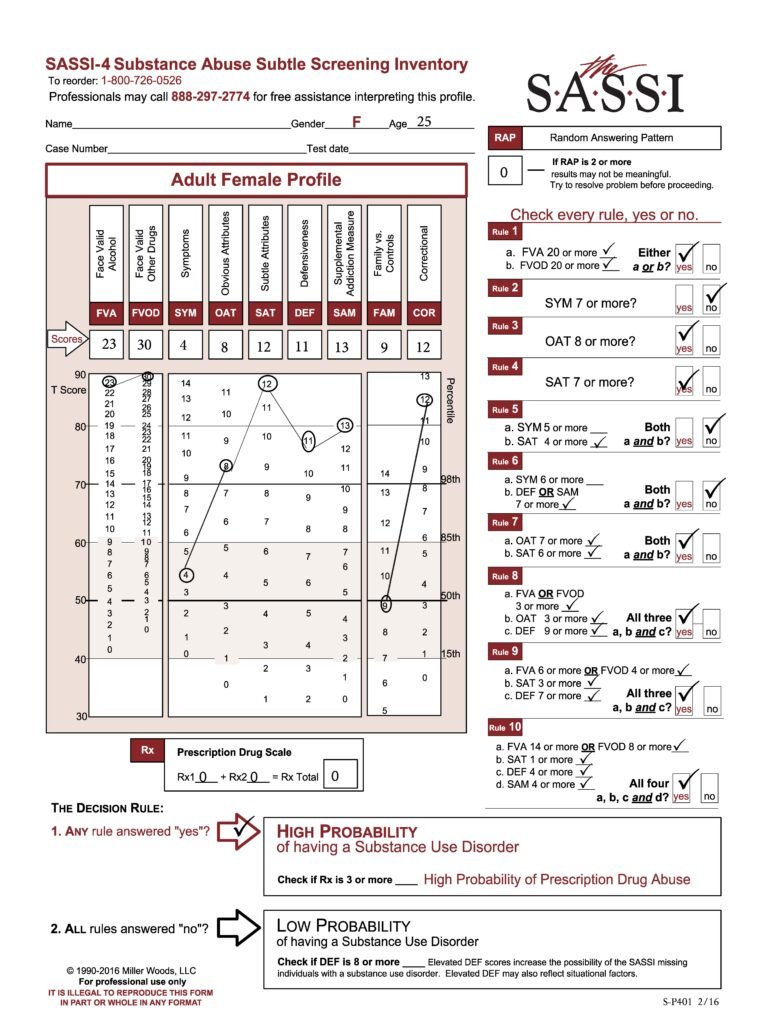
The SASSI is made up of both face-valid scales and subtle scales. Face-valid scales such as FVA, FVOD and SYM are scales that are very obvious about what they are measuring, while subtle scales such as OAT, SAT and DEF are made up of items that do not seem to have anything at all to do with substance use. Our case study analysis showed that certain behaviors, characteristics or patterns emerge in individuals who score as high probability based only on subtle scales. Let’s take a look at an example. Byron is a 31-year-old male who was asked to be evaluated because of a child custody battle in which the mother alleges that Byron misuses drugs. Byron has not yet had a comprehensive assessment done, but has so far only admitted to some occasional use of marijuana. A SASSI was administered and the results showed that Byron met the criteria for Decision Rules 3, 4 and 7. Each of these decision rules involve only subtle scales and no face-valid scales. So, what characteristics do we tend to find in individuals with this type of scoring pattern?

One key feature of this type of scoring pattern is the fact that these individuals often have very little insight into the pervasive nature of the addictive disorder in their lives. Most of the time, this type of client actually has a very sincere delusion regarding their substance misuse. In other words, they are not trying to trick you into thinking they do not have a problem with substances; they simply do not see it. Often, every single activity this person is engaged in and every decision they make somehow involves substance use. Often, the substance misuse has become an unhealthy way to cope with emotions that are too overwhelming and so individuals with this type of scoring pattern are very emotionally avoidant. Many times, this individual has difficulty admitting their weaknesses or the personal limitations with which they struggle and instead choose to focus on very superficial things, ignoring the depth of the substance problem in their life. We can see these types of traits and behavior patterns manifested in this client’s individual face-valid scale scores such as lower than average (T-score of 50 is the mean) FVA and FVOD scores and only an average SYM score. These all indicate a client who does not acknowledge or admit to having any significant problems or negative consequences as a result of substance use. The client’s extremely high DEF score indicates a very high level of guardedness and the desire to be seen as having no weaknesses or faults. It’s even possible that the FVA, FVOD and/or SYM scale scores could be artificially low because of minimization of symptoms in the client’s answering patterns on these scales fueled by this defensiveness. However, as mentioned previously, it’s possible and even probable that this client really has very little insight into his problem with substance misuse and so he may be unable to even recognize the obvious negative consequences he is experiencing. This is especially typical of clients with high SAT scale scores as this client has. While this client does also have an equally high OAT score, which often indicates some ability to recognize negative attributes that are common in individuals with substance problems such as impulsiveness, self-pity, resentment, and impatience, it is more likely in this case that the client does not see these issues as having any relationship to his misuse of substances.

At this point, a comprehensive assessment needs to be done along with a formal diagnosis and possible treatment plan formulated. Since the SASSI does not provide an actual diagnosis and does not, by itself, indicate a need for treatment or the level of treatment, it is important to gather more information such as self-reports of the client’s current usage patterns, collateral reports, naturally occurring records, behavioral records, etc. to determine a diagnosis and course of action. Typically, clients with this scoring pattern do have a significant substance use disorder and many of them, if they need treatment, will often need a relatively intensive level of treatment which includes individual and group therapy sessions; more than just cognitive/educational programming. However, individuals with this type of scoring pattern will often be initially resistant to any treatment as they honestly do not see a problem that needs to be treated. The high level of defensiveness will require lots of time spent in developing a therapeutic alliance and positive rapport, affirming and supporting him throughout the process. Clients like this are often a high relapse risk and so it is important to provide wraparound supports and a level of intensity in the treatment regimen which allows for quicker and stronger intervention in the event the client attempts to relapse. Individuals who score as high probability of a SUD based only on subtle scales are often some of the most challenging clients, but with information gained from the client’s scoring patterns on the SASSI combined with additional information from other sources, you are in a better position to know what to address to increase the possibility of success with this client.

Don’t forget that full training on administering/scoring the SASSI and clinical interpretation of the sub-scales is available. Check out https://sassi.com/sassi-training/ to register for an upcoming training. Also, our free Clinical Helpline is available M-F from 1:00pm to 5:00pm EST to answer any questions you have about the SASSI.

PDF Version Available for Download

Help Us Shape the Future of SASSI Online

At The SASSI Institute, our mission has always been to provide you with tools that make your work easier, more accurate, and more effective. SASSI Online has grown into an important resource for clinicians, educators, and professionals in the field of substance use screening — and that growth is thanks to the support and feedback of our valued customers.

Now, we’d like to hear directly from you.

What features would make SASSI Online even more useful in your daily work?

  • Are there tools or functions that could save you time?
  • Are there any enhancements to reporting, data management, or integrations that would make your workflow smoother?
  • Is there something you’ve always wished SASSI Online could do?

No suggestion is too small or too big. Whether it’s a streamlined way to organize client assessments, a new type of dashboard, or a feature you’ve seen in other platforms that you’d love to have here—we want to know.

Your input will help guide our development team as we continue to improve SASSI Online and ensure it remains a tool that truly supports your practice.

👉 Please share your ideas with us by clicking here.

Thank you for being part of the SASSI community and for helping us shape the future of SASSI Online!

Reflecting on a Year of Service

Looking back at this past year, we are proud of the work we’ve accomplished together. The accurate, subtle screening provided by the SASSI instruments – including the Adult SASSI-4, Adolescent SASSI-A3, and Spanish SASSI – remain cornerstones for evidence-based decision-making in diverse clinical settings.

This year, we’ve focused on:

  • Enhancing Clinical Insight: Providing professionals with the training and resources needed to interpret SASSI profiles, helping you understand client dynamics, even those who may be minimizing or unaware of their substance use.
  • Supporting the Recovery Community: Sharing valuable insights and research through The SASSI Network, contributing to the broader conversation and dialogue around substance use disorders.
  • Streamlining Your Work: Continuing to improve the SASSI Online platform to make administration and scoring as efficient as possible, giving you more time to focus on your clients.

If you work with DUI offenders, in 2026 we encourage you to consider incorporating the Behaviors & Attitudes Drinking & Driving Scale (BADDS) which identifies preintervention risk of future impaired driving, and changes in DUI-related risky behaviors & attitudes following intervention. It is ideal for initial risk assessment, pre and post-test screening, and program evaluation. Training is available

Every accurate screening and every step toward appropriate treatment is a testament to the powerful combination of sound clinical tools and professional expertise. We look forward to our continued collaborations.

Use of The SASSI in Identifying Factors in Crime and Criminal Recidivism

Although there have been ample demonstrations of the value of rehabilitation programs for criminal offenders, it is important to recognize that recidivism in the criminal justice system remains a serious problem.

It would be an easy matter to greatly reduce the incarcerated population if one and only one factor caused people to have multiple arrests. Substance Use Disorder (SUD) is a strong common element among repeat offenders. However, there are numerous other factors that can also lead to habitual legal offensives – impulse control problems, personality disorders, psychiatric disorders, cognitive impairment, chronic stress, a history of trauma, childhood and other developmental issues, peer culture, poor social skills, etc.

No single factor necessarily causes criminality, but each one can contribute to a tendency toward law violation, and they can combine to produce a high-risk profile. Because there are multiple causes of criminality, one treatment program may be of value for some repeat offenders but still does not address all the issues that need to be addressed to prevent further legal difficulties. Repeat offenders do not come from one mold. Therefore, one given course of treatment is not likely to be maximally effective for all recidivists.

Screening to Identify Risk

The challenge of early intervention is to find a means of identifying and addressing risk. A first step in reducing recidivism in the criminal justice system is to screen legal offenders to identify individuals who are at greatest risk for ongoing legal difficulties and who are likely to have an SUD to provide them with appropriate and timely treatment.

SUD is strongly related to legal problems. Using SASSI screening tools can provide information on ongoing legal problems that can be helpful in treatment planning. Since there are multiple causes of habitual offending, instruments that measure a single factor are not likely to be effective in early identification of high-risk individuals. The SASSI Correctional (COR) Scale identifies individuals with a history of legal problems. While it is unclear why the COR items identify these individuals, there are many possible factors to explore, including: impulse control, anger management, high risk-taking, not responsive to consequences of behavior, low frustration tolerance, and poor social skills.

Effective Screening

Screening is a first step; but a vital and cost-effective first step, particularly in settings that process large numbers of clients. After identifying high-risk individuals, it is important to gather information that is useful in developing a treatment plan.

Client-Appropriate Treatment

There is real value in gathering information that is directly useful in planning therapeutic interventions that will address the client’s specific needs. When screening and assessment are conducted with the intent to help the professional join the client in setting effective treatment goals and planning how to achieve them, the screening and assessment becomes a vital part of the treatment process. It is important to use tools that are accurate and provide clinically useful information.

Despite the overall effectiveness of SUD treatment and despite the demonstrated cost-effectiveness or providing treatment as part of society’s response to criminality, rehabilitative diversionary programs are not maximally effective in reducing rates or recidivism. Part of the solution lies in developing interventions that are sensitive to subgroup differences and individuals’ needs. Individuals with SUD differ from one another. They therefore respond differently to different types of treatment.

Matching treatment on the basis or the nature and degree of the client’s psychopathology and sociopathy increases the effectiveness of the treatment. While it may not be possible to fulfill all the mandates, if we wish to reduce recidivism within the criminal justice system, it is necessary to identify the individuals most at risk, determine their treatment needs, and provide treatment tailored to those needs. The SASSI screening tools can be a very helpful first step in that direction.

The SASSI as a Cost-Effective Screening Tool in Criminal Justice Programs

Working with mandated clients can be challenging. Mandates are in place with goals to reduce crime, decrease recidivism in the criminal judicial system, lower the prison population, and cut back on substance use and addiction.

These are all great goals; however, achieving them can be more difficult than proclaiming them. Professionals in the fields of health care,criminal justice. and other social services are given the charge of executing the mandates and bringing the goals to fruition.

Addiction is a serious and widespread health problem: it has a devastating impact on individuals, their significant others, and society. As a health care problem, substance use disorder (SUD) is tied to issues in criminal justice. One of the common consequences of SUD is legal difficulties.

Money, a central issue underlying all mandates, is certainly a complex issue in SUD treatment. It costs money to treat SUD, but it costs more not to treat individuals suffering from them. With so many cutbacks and rising costs, professionals have been asked to do more with less. We are asked to balance the complex and often contradictory needs of our clients, referral sources, funding agencies, boards of directors, and society.

SUD treatment is intimately tied to the criminal justice system. Many of us work directly within the criminal justice system, and many more of us serve clients who are referred by colleagues from courts and correctional programs. There is an expectation that our services will address the mandates. We are expected to rehabilitate individuals, cut back on drug abuse, reduce crime, lower jail populations, and be cost-effective. We are expected to do more, do it better, and do it all with fewer resources. One way to cut back costs is by conducting early interventions. The SASSI screening tools help address the challenge of early intervention by providing a means of identifying and addressing risk. A first step in reducing recidivism in the criminal justice system is to screen legal offenders to identify individuals who are at greatest risk for ongoing legal difficulties and who are likely to have an SUD to provide them with appropriate and timely treatment.

SASSI Instruments

The SASSI Institute offers the following brief and easily administered psychological questionnaires:

SASSI-4 | Adult Substance Abuse Subtle Screening Inventory-4

Identifies high or low probability of substance use disorders in adults 18 and older and includes a prescription drug scale that identifies individuals likely to be abusing prescription medications. It also provides a measure of profile validity and clinical insight into level of defensiveness and willingness to acknowledge experienced consequences of substance use disorder.

SASSI-A3 | Adolescent Substance Abuse Subtle Screening Inventory-A3

Identifies high or low probability of substance use disorders in adolescent clients ages 13-18. It also provides clinical insight into family and social risk factors, level of defensive responding, consequences of substance misuse teens endorsed, and a prescription drug abuse scale that identifies teens likely to be abusing prescription medication.

Spanish SASSI | Spanish Substance Abuse Subtle Screening Inventory

A Spanish language screening instrument empirically validated in clinical settings for use with Spanish-speaking adults from diverse ethnic backgrounds.

BADDS| Behaviors & Attitudes Drinking & Driving Scale

Identifies preintervention risk of future impaired driving, and changes in DUI-related risky behaviors & attitudes following intervention. Ideal for initial risk assessment, pre and posttest screening, and program evaluation.

We invite you to reach out to us for additional information and with any questions you may have at 800.726.0526. Training is available on all instruments.