The following is a message to individuals in need of recovery from a family member & friend of mine. Please share it with those who you feel may benefit from it so they can see there is hope for a better way. ~ Scarlett (SASSI Training Director)
“I know there are some very special people out there still struggling with addiction so I’m going to put this out there for you all to see.
I loved doing meth. And I am not going to rewrite my story and pretend that I did not. Meth made everything quiet. The pain, the fear, the memories, the shame. Meth gave me the energy to keep going when my entire life was falling apart. Until eventually, I was not getting high to feel good anymore. I was getting high because I did not know how to exist without meth or other drugs. My entire life revolved around them.
Where I was going to get them.
How I was going to pay for them.
Where I was going to sleep.
How long until I got sick.
How was I going to get more meth to get back up again (Already thinking about that before I even ran out ~ if you know, you know).
I lived in my car. I slept on sidewalks and trap house floors, and I was totally content with that ~ because it was normal, right?~. I put myself in dangerous situations and let people treat me in ways I never thought I would tolerate. I even left the hospital while critically sick because getting high felt more important than staying alive.
That is ADDICTION!
Watching your entire life burn to the ground and still choosing the thing that lit the darn match.
But on January 5th, 2015, I stopped running. Recovery did not magically give me a beautiful life. I had to build one. I learned how to feel without getting high. How to survive bad days without destroying myself. How to love and be loved. How to become someone I actually wanted to be.
So to addicts from an addict, the woman who once slept on sidewalks and trap house floors now helps other women get sober. I went back to school. I built a career. I built a life I never thought I would live long enough to have. And in 5 months I will have TWELVE YEARS clean. And of course, my GOD gets all the glory.
I loved meth for what it made me forget. For the billions and trillions of dopamines that it gave me and for the energy it gave me to get through my everyday life. Let’s not forget the 5am energy that it gave us to sort tiny little objects like paperclips, coins, or beads by shades of color or size for hours on end (we don’t ask why and we don’t judge over here). Meanwhile over there somehow, we have no energy to put back any of the 50,000 projects we’ve tore apart and started knowing we’ll never finish them (but hey, sounded like a good idea at the time) again ~ if you know, you know.
Every September, National Recovery Month serves as a vital reminder that prevention works, treatment is effective, and people do recover. Across schools, healthcare facilities, and justice systems, professionals work tirelessly to help individuals overcome substance use disorders. However, early detection and clear insight remain two of the biggest hurdles to starting that journey.
Identifying substance use issues early—and without bias—is critical to guiding individuals toward appropriate care.
The Role of Objective Assessment in Recovery
Recovery is never a one-size-fits-all process. Effective support relies on accurate, evidence-based tools that help practitioners see past defensiveness, denial, or fear.
Bypassing Resistance: Individuals who are hesitant to disclose substance use often minimize their symptoms. Standardized screening instruments provide objective data that helps clinicians start honest conversations.
Informing Targeted Interventions: By distinguishing between low or high probability of a substance use disorder, practitioners can route individuals to the exact level of care they need.
Supporting Early Identification: In settings like high schools, employee assistance programs (EAPs), and community corrections, identifying early warning signs allows for proactive help before crises escalate.
Moving Forward Together
National Recovery Month is a time to honor the resilience of individuals in recovery and recognize the dedication of the professionals who support them. Having the right tools in place ensures every individual gets a fair, accurate start on their path toward lasting health and independence.
Recovery is rarely a straight line, and it almost never starts in the same place for any two people. It begins in quiet moments—a decision to seek help, a conversation with someone who listens without judgment, or the realization that a different future is possible.
During National Recovery Month, we celebrate the courage it takes to step onto that path and honor the strength of those walking it every day.
Healing starts with understanding: Before treatment, coping strategies, or support networks can take root, an individual needs to be seen clearly and met right where they are.
Hope is a shared effort: Recovery doesn’t happen in isolation. It thrives in communities, families, and spaces where people feel supported rather than defined by their struggles.
Every step counts: Whether it is day one or year ten, every effort toward wellness and stability is a victory worth recognizing.
To anyone currently on the journey, supporting a loved one, or helping others find their way: recovery is real, it is achievable, and your story matters.
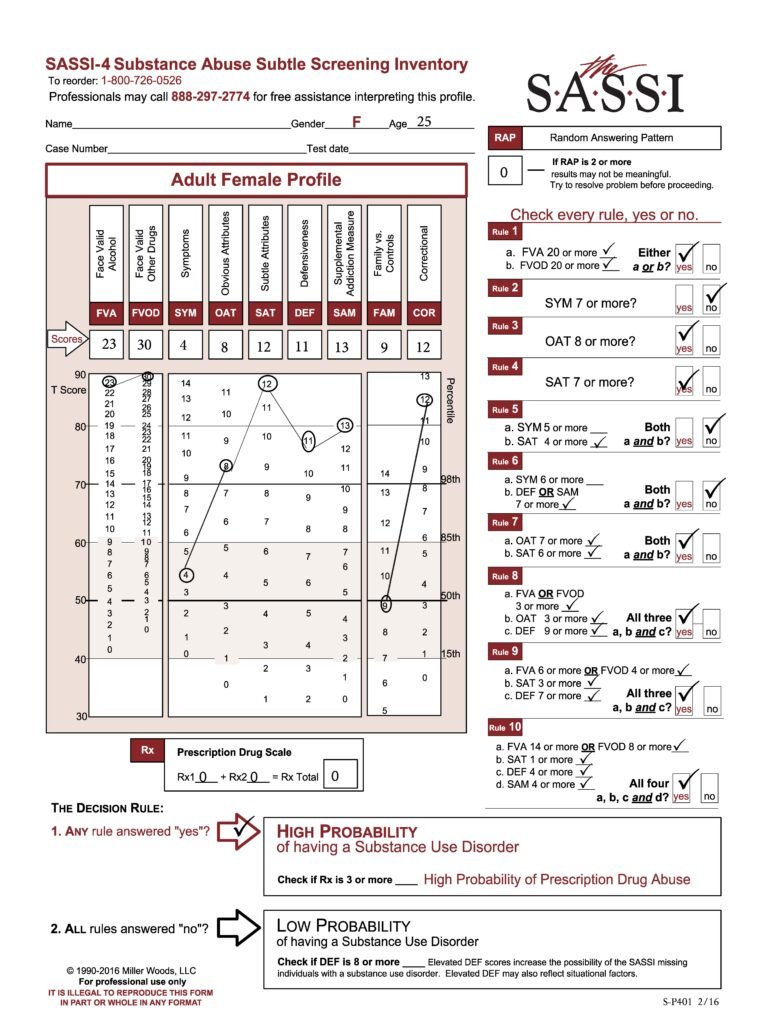
This very unusual profile was called in to our Clinical Helpline Staff and provides us the opportunity to discuss several key issues with regard to clinical interpretation of individual SASSI scale raw scores:
It is critical to gather additional information beyond the SASSI from reliable sources and then integrate this information with the basic foundational scale interpretations provided by our case study research;
When highly unusual scale scores occur, seemingly contradicting one another, resist the temptation to over-interpret and;
Notice when scale score interpretations suggest potential problem areas beyond just the substance use disorder issues and make a plan to address these.
This client profile is a clear example of the need for additional clarifying information about the client. The only information we were given was the client’s biological sex (female) and their age (25 years old). What makes this profile confusing is that the individual scale scores sharply deviate from “normal” scoring patterns in a few places, which leads to scale interpretations that seem to contradict one another. For example, the client has clearly acknowledged that she has had or is having significant negative consequences, problems or trouble as a result of her use of both alcohol and other drugs (FVA=23 and FVOD=30) and therefore may have lost control of her use and may be using as a coping mechanism. These scores are extremely high compared to the general population and typically leave no doubt that this person has most certainly crossed the line into substance addiction and is quite willing and able to recognize and admit the severe consequences her substance mis-use has caused in her life. This is further confirmed by an extremely high OAT scale score of 8 which would generally be interpreted to mean that this person greatly identifies with many of the usual negative attributes or personal limitations/weaknesses that are common among those with active substance use disorders (e.g. impatience, resentment, self-pity, impulsiveness, restlessness) and usually, if asked, would readily admit to sharing many similarities with those who have substance problems. Lastly, her SAT scale score is also extremely high, once again strongly indicating a person with a significant substance problem.
But there are other scale scores which seem to contradict some of these basic interpretations. For example, the client has a DEF score of 11 which is far above the 98th percentile and suggests that the client is answering the questions in such a way on this scale that would indicate someone who would tend to not share anything about herself that would put them in a bad light or show weakness or vulnerability. DEF scores like this usually tend to suggest a client who wants to appear as if they have it altogether as they are endorsing only positives about themselves. How can this be true though if their FVA/FVOD and OAT scale scores are so high that they strongly indicate a person who is able to admit and acknowledge numerous negative consequences from substance mis-use and is able to strongly identify with many of the same negative attributes or weaknesses that are often found in those with active substance disorders? In addition to that, how can this client have such extremely high scores on FVA and FVOD and yet have a relatively normal score of 4 on the SYM scale? The SYM scale, like the FVA/FVOD scales, is also a very obvious, face valid set of questions about problems with substance use and yet her score on the SYM seems to indicate relatively none of the typical symptoms we would associate with one struggling with a SUD. One possible reason for the discrepancy between the scores on the FVA/FVOD scales and those on the SYM scale would be because of the timeframe that the client was asked to use in answering the FVA/FVOD scale questions. Unfortunately, we were not given this information about this client profile, but if the client was asked to answer the FVA/FVOD questions based on their entire life, then the scores could be quite high but be representative of a time in the distant past. Since the T/F questions have no specific timeframe associated with them, the client may have answered the SYM questions based on a more recent timeframe in which they had achieved some level of sobriety.
Even the extremely high SAT score seems a bit contradictory with other scale scores since usually a high SAT score would indicate someone who is not able to admit or acknowledge that they have a substance problem. However, since the SAT score was positioned higher on the graph then the OAT scale score, our research suggests that individuals with that type of scoring pattern are sometimes able to admit to the very obvious consequences of their substance misuse (when OAT and Face Valid scale scores are high like this client) and may even be able at times to self-identify to a certain extent with certain obvious behavior patterns that often lead to substance misuse. However, people with very high SAT scores, and especially ones that are higher on the graph then the OAT score, are often not able to see the deeper, underlying, less conscious issues that are constantly plaguing them and significantly influencing their substance misuse behaviors in a much more covert way. They often simply cannot see the pervasive nature of the disease acting in their everyday life. They often are emotionally avoidant and superficially may believe that their substance problems are just a set of bad habits that they can stop on their own. They see the physical manifestations of the problem, but are unable or unwilling to see the emotional and spiritual aspects of the problem. They often will actively avoid treatment that involves examining their negative thought patterns, deeply held negative beliefs, fears, and other deeply rooted issues that have a stranglehold on their life and behaviors. Some of these clients will incorrectly assume that their substance problems only reside with their use of the “hard” drugs and if they just quit using those, then they can continue to drink and smoke marijuana and all will be well.
This explanation actually helps us to better interpret the client’s very high DEF score as well. While the client is able to admit and acknowledge having a lot of problems and trouble as a result of her use of alcohol and other drugs as seen in her very high FVA, FVOD, and OAT scores, her very high SAT and DEF scores show that her admission and acknowledgement is only at a very surface level. In other words, she admits all the things that are pretty much already part of the public record and everyone knows about, but the problem is much deeper than that and she is oblivious to how deep and pervasive it really is. This is what we would call a sincere delusion. She admits what she is aware of and what she feels she has control over. But there is much more beneath the surface that she can’t see. Her defensiveness is potentially a way for her to demonstrate that she’s in control, that there’s nothing to see here and everyone should move on. Like her very high SAT score implies, she may be unable to identify or get in touch with her real emotions and pain and she may have situational reasons or life experiences which have taught her to not let people see her flaws or weaknesses, the real her. She will tend to focus away from internal processes and look instead at tasks and factors outside of herself. This increases the likelihood that she may put herself at risk without awareness of her own vulnerability. She will be more likely to find excuses not to engage in treatment and recovery activities, especially if she is able to achieve short spurts of sobriety. Once the challenge of proving she can abstain from alcohol or drugs for a short time loses its luster or crises arise that she cannot cope with on the basis of her more superficial focus, she will be more likely to relapse.
The risk of relapse is particularly increased given her similarity to others who violate cultural norms sufficiently to have repeated involvement with the criminal justice system, as evidenced by her elevated COR scale score (COR=12). In addition, the elevated COR score suggests increased risk for future criminal behavior independent of the client’s substance use or mis-use. A comprehensive assessment of underlying risk factors in the client such as poor social skills, anger management issues, poor impulse control or low frustration tolerance would be a valuable exercise so that, if any of these issues are uncovered, an effective treatment plan that specifically addresses these issues could be developed to potentially decrease the risk of repeated involvement with the criminal justice system.
In summary, this young woman’s profile indicates three problem areas that need to be the focus of potential treatment: her substance use disorder (if diagnosed), her defensiveness, and her risk for legal problems. This client meets SASSI Decision Rules indicating a high probability of a substance use disorder. While the SASSI does not specifically provide a prediction of the level of the disorder (i.e. mild, moderate or severe), typically clients with FVA/FVOD, OAT and SAT scores as high as this client’s often have moderate to severe disorders if the disorder is active. The scores also suggest a pattern of addictive behaviors that have a pervasive influence on her life, which she is not likely able to fully recognize or accept. She most likely has little or no self-awareness with regard to her underlying emotional pain and may tend to shift responsibility or blame to her life situation and/or other people.
In light of this, she will most likely resist many conventional forms of treatment and prefer to “fix it” herself. There is a high risk of premature self-labeling as “cured” after one or two successful short attempts at sobriety, ultimately resulting in full blown relapse. The risk of future criminal behavior is high, suggesting that compliance with other rules may also be problematic. Further assessment and/or building in a specific treatment focus on this risk through cognitive-behavioral interventions would be reasonable options to consider.
In trying to interpret the individual scale scores for this client, one can see that, while the foundational interpretations that normally apply to certain scoring patterns certainly can lead us in the right direction, without more data from other reliable sources, one can only speculate as to why some of the standard scale score interpretations initially seem to be in contradiction with one another. With more information from collateral sources (family, teacher, employer, coach, friends, etc.), naturally occurring records (e.g. arrests, ER visits, prior treatments, etc.) or behavioral records (work behavior, school behavior), we could more easily narrow down, shape and confirm or deny our initial interpretations.
Getting additional information from other sources also can help us to resist over-interpreting. In the absence of clear information, one is more likely to speculate. While no SASSI interpretations are ever meant to be considered absolute, we can nevertheless trust that the foundational interpretations which came from our case study research have proven to be quite reliable and accurate in most cases. But when individual scale score interpretations seem to clash, we have to resist making up information and therefore over-interpreting or mis-interpreting and instead gather actual data that could more correctly resolve the perceived conflicts.
And finally, spend time learning and practicing how to utilize the SASSI foundational scale score interpretations in combination with other reliable sources to identify and address any other non-substance-specific challenges facing the client. These could range from defensiveness and high risk of involvement in the criminal justice system like this client to possible depression, suicidal ideation, or typical symptoms associated with co-dependency. While the SASSI’s primary function is not that of a depression, suicide risk or co-dependency screening, basic scale score interpretation can provide clinicians with a “heads up” on the possibility of these and other issues, prompting the clinician to do further evaluation in these areas and develop treatment plans, educational resources and/or referral plans to address them.
To become more familiar with clinical interpretation, we invite you to attend one of our training sessions taught by a SASSI-certified trainer ( https://sassi.com/sassi-training/) and/or to utilize our free Clinical Helpline at 1-888-297-2774 which is available Monday – Friday from 1:00pm – 5:00pm EST to assist clinicians in learning how to interpret their client’s results better.
The Substance Abuse Subtle Screening Inventory (SASSI) is an essential clinical tool for identifying substance use disorders (SUD). While toxicology tests only detect recent drug presence, the SASSI penetrates denial and hidden use to evaluate the underlying psychological probability of an SUD with up to 92% accuracy.
When determining the most effective method for identifying a substance use disorder (SUD), many healthcare providers and criminal justice professionals weigh biological drug testing (toxicology) against psychological screening tools. While both methods have their place in both healthcare and criminal justice, the SASSI often proves to be the superior clinical tool for identifying a SUD.
The SASSI screener stands out as a more effective, comprehensive solution than a standard toxicology screen because of the limitations of toxicology screening. Toxicology screening—typically done via urine, blood, or hair—is highly effective at identifying the biological presence of specific substances or their metabolites. However, it has distinct limitations:
The Detection Window: Toxicology only provides a snapshot of very recent use (usually a few days to a week). A drug test tells you if a substance is in the system only.
Misses Alcohol Use: Standard 5-panel or 10-panel drug screens often do not test for alcohol or fail to give a full profile of alcohol misuse.
Does Not Account for Denial: Many individuals who struggle with addiction will alter their usage before a test or intentionally attempt to “pass” otherwise positive drug screens.
Rather than testing the body, the SASSI assesses behavioral patterns, psychological symptoms, and the consequences of substance use.
While toxicology confirms the presence of a chemical, the SASSI provides a comprehensive clinical picture of a substance use disorder:
1. Identifies Hidden Use and Denial : Because the SASSI includes indirect, subtle items, it can flag individuals with a high probability of having a SUD even if they are intentionally lying or minimizing their habits on face-value questionnaires. You cannot “cheat” the SASSI by simply abstaining from drugs for 24 hours prior to a test.
2. Profiles Alcohol Use Effectively: Alcohol remains one of the most widely abused substances, yet it has a very short biological detection window. Studies have shown that the SASSI is highly selective in pinpointing alcohol misuse profiles that are completely missed by urine toxicology.
3. Assesses the Probability of an SUD: A negative drug test does not mean a person is free from addiction. The SASSI categorizes the probability of a SUD, helping professionals in their determination of the possible type of treatment needed (e.g., outpatient counseling, intensive outpatient programs, or inpatient detox).
4. More Cost-Effective – Research evaluating substance abuse screening methods found that relying on the SASSI combined with patient history is more cost-effective and clinically accurate than relying solely on toxicology screening.
Toxicology testing is excellent for verifying immediate chemical presence, but it falls short in identifying the presence of an addiction. By looking beyond recent biological usage and diving into psychological and behavioral patterns, the SASSI screener offers a far more accurate, reliable way to help individuals on the path to recovery.
SASSI Institute is proud to continue to offer its customers a free Clinical Help Line to assist professionals in the use and interpretation of Substance Use Subtle Screening Inventory (SASSI) screenings performed on their clients. The Help Line is available Monday through Friday (except holidays) from 1:00 PM to 5:00 PM (EST) at 800-697-2774 (Option 2). This dedicated service provides direct access to experienced SASSI-trained clinicians who can assist with questionnaire administration, scoring, and interpreting basic or complex client profiles.
Accurately identifying and addressing substance use disorders (SUD) is both critical and challenging. The SASSI screening tool can be an important part of that diagnostic process. Especially when working with clients who are highly resistant or in denial, clinical interpretation of screening results can often leave clinicians with uncertainty and questions. That is exactly where our free Clinical Help Line comes into play. Our experienced licensed clinicians can provide insights into how the individual SASSI scale scores could be interpreted and how this information could potentially be used to best benefit the client.
Our Clinical Help Line is a free confidential resource designed specifically to support professionals who use the SASSI tool with their clients. Utilizing this resource allows you to potentially learn more about your client and build an even stronger rapport with them by increasing their awareness and understanding of how their substance use may be impacting their life. Discussing the potential meanings underlying their individual raw scores on each of the SASSI scales can help clients better comprehend the significance of their behaviors and provide the professional and client the opportunity to collaboratively identify goals to address these issues.
The next time you review a SASSI profile and need a second opinion or clarification prior to discussing the results with your client, don’t guess—consult with the experts. Call 800-697-2774 (Option 2) Monday thru Friday from 1:00pm – 5:00pm EST to keep your clinical screenings accurate, informed, and highly effective. And remember, it is free of charge and there is no limit to the number of times per day or week that you can call to discuss your clients’ SASSI results! Give it a try!
We invite you to join us for a free one-hour SASSI Clinical Q&A webinar hosted by our Clinical Director, David Helton, LMSW, LCDC. The Q&A is for anyone new to using the SASSI, those considering using the SASSI, or seasoned veterans at screening with the SASSI. The Q&A is scheduled from 11 am – Noon ET on: July 14th, 2026. You can save your spot by clicking here.
We welcome you to share profiles to discuss with the group by sending them (de-identified) via email any time prior to the session to scarlett@sassi.com. These profiles will help others learn about SASSI and offer insight into the various profile configurations.
Note: Q&A sessions do not provide CEUs and are not a substitute for SASSI Training. To register for a SASSI Training webinar. please visit https://sassi.com/sassi-training-online/.
Individuals who are screened for substance use disorders often have presenting complaints related to other psychological and medical health issues, as well as difficulty in functioning and adjustment in other life domains (e.g., work, parenting, financial, and legal). It is important, therefore, that a screening instrument used to identify individuals in need of further evaluation for substance use disorders is able to discriminate between SUD and other mental health issues or poor adjustment and functioning.
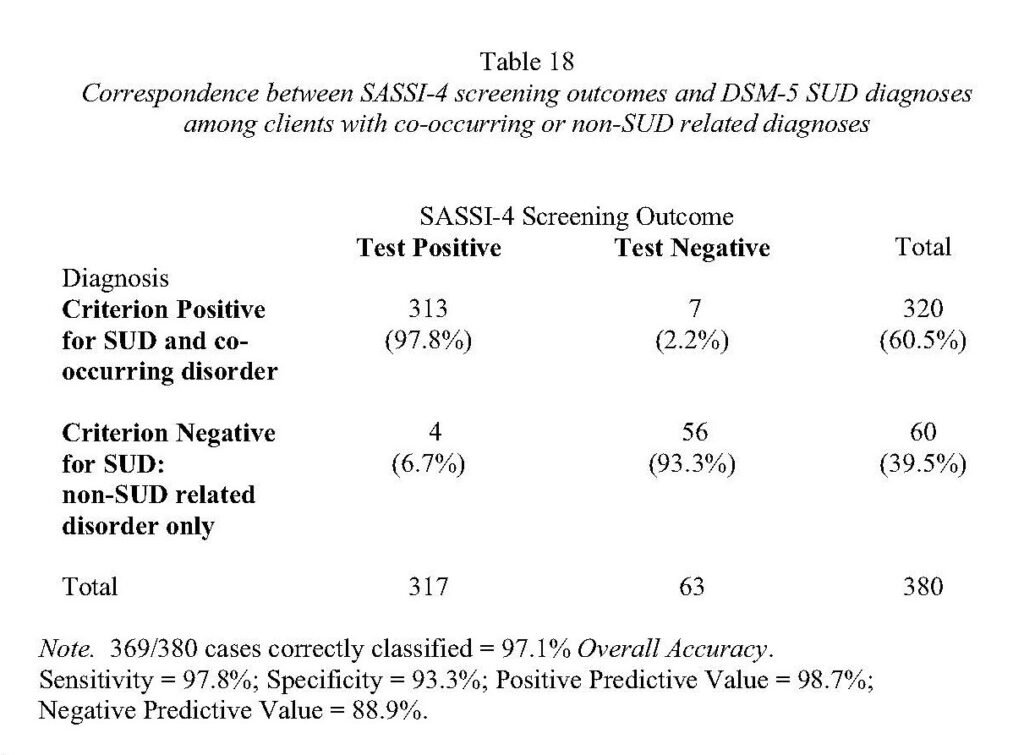
Analyses were conducted to evaluate the accuracy of SASSI-4 SUD screening out-comes in a sample of individuals who had co-occurring psychiatric disorders (i.e., dual diagnoses for SUD and one or more psychiatric disorders such as depression, anxiety, post-traumatic stress disorder, etc.) and a sample of individuals who were diagnosed as not having a substance use disorder but who did have one or more non-SUD related diagnoses (i.e., were criterion negative for SUD).
Findings are presented in Table 18 and indicate excellent SASSI-4 screening sensitivity in detecting SUD in clients who had both SUD and another psychological disorder. Findings also showed high specificity in producing negative SASSI-4 screening outcomes for individuals who were diagnosed with non-SUD related disorders only. Overall SUD screening accuracy in this sample was 97%. These findings provide evidence of construct validity and the precision of the SASSI-4 in identifying likely SUD specifically, rather than identifying individuals who may be in need of treatment for life stressors, poor adjustment and functioning, or other psychological health issues.
Extracted from:
Lazowski, L. E., Kimmell, K.S., & Baker, S.L. (2016). The Adult Substance Abuse Subtle Screening Inventory-4 (SASSI-4) User Guide & Manual. Springville, IN: The SASSI Institute.
Substance use disorder is an important topic in our society. The internet, social media, and television provide us with information about new treatment programs and the ongoing political discussion of the seriousness of the problem.
The SASSI Institute gives thanks to the dedicated workers who, day-by-day, face the task of helping people who have become part of the fabric of pain that surrounds substance-related disorders. The daily efforts of practitioners, support staff, and program managers may not be newsworthy, but those efforts reflect a sense of caring and commitment that is inspiring.
We strive to make the SASSI as user friendly as possible. The following are links to download the basic Guidelines for interpreting the SASSI scales.
As always, our clinicians are available to help you with questions about administering and/or interpreting the SASSI on the Clinical Helpline at 800-697-2774 Option 2 Monday through Friday, 1 pm to 5 pm (EST).
While the core goal of identifying substance use disorders remains the same, the SASSI-4 (Adult) and SASSI-A3 (Adolescent) are tailored to the very different life stages and behavioral patterns of their respective groups.
Think of it this way: the way an adult hides a drinking problem is often very different from how a teenager masks drug use.
Comparison of SASSI-4 vs. SASSI-A3
Feature
SASSI-4 (Adult)
SASSI-A3 (Adolescent)
Age Range
18 years and older.
13 to 18 years.
Focus Area
Emphasizes long-term behavioral patterns.
Emphasizes family dynamics, peer pressure, and school behavior.
Subtle Items
Focuses on adult stressors like workplace issues and long-term social consequences.
Focuses on “acting out,” rebelliousness, and emotional regulation.
Key Differences in Approach
The Adolescent Version (SASSI-A3)
Teenagers are often in a state of natural rebellion or may be experimenting due to peer influence rather than chronic dependency. The A3 is specifically designed to:
Filter Peer Influence: It helps distinguish between a teen who is “experimenting” because of friends and one who has a burgeoning clinical dependency.
Assess Family Environment: It includes scales that look at the teens’ perception of their home life, which is a major factor in adolescent recovery.
Evaluate “Global” Functioning: It looks at how substance use is impacting their development (school performance, legal trouble, and social skills).
The Adult Version (SASSI-4)
Adults typically have more established defense mechanisms and more to lose (jobs, marriages, custody). The SASSI-4 was recently updated to better capture:
Prescription Medication Abuse: Since the opioid crisis, the adult version has been refined to better identify those misusing legal prescription medications.
Severity Markers: It provides more nuance on the intensity of the disorder, which helps in planning for long-term recovery versus short-term intervention.
Why the Distinction Matters
Using an adult test on a teenager (or vice versa) could possibly lead to inaccurate results. A teenager’s natural impulsivity might look like a “disorder” on an adult scale, while an adult’s more calculated “denial” might not be caught by a test designed for a more impulsive adolescent.
The purpose of the SASSI is to help identify people who are likely to have substance use disorders so that early intervention and treatment can be initiated when appropriate.