Tag: SASSI

We Want to Hear From YOU!

Here at The SASSI Institute we pride ourselves on the work we do to provide validated instruments that help you, as well as your clients.  To do an even better job, we are asking for your feedback.  We want to know how our instruments support your work.  But we also want to hear how we can improve our tools.  Our new Feedback Form gives you an outlet to share your ideas and critiques. 

Click here to complete the feedback form.

If you have a heartwarming experience you would like to share about how our instrument has helped you or a client, we would love to hear that too.  Please feel free to share your story* with us at blog@sassi.com.

*Please exclude identifying client information from the submission

New Professional Development Webinars Available

The SASSI Institute is pleased to announce that we are launching a line of Professional Development webinars. We will be doing these in partnership with guest lecturers on topics that may be of interest to professionals in the addiction field.

Our first such webinar is Comprehensive Screening & Advanced Assessment of Addiction presented by Dr. Don Osborne. Below is additional information on this workshop:

The Screening and assessment processes are critical to effective addiction treatment. In fact, treatment can only be as effective as the thoroughness of the assessment process. The screening and assessment processes can and should result in clients’ reduced denial or “resistance” and easily transition into therapy.

In this training program you will be able to:

  • Understand screening and assessment.
  • Be able to describe a comprehensive concept of addiction’s progressive nature with problems, tolerance and loss of control.
  • Be able to determine the kinds of questions to ask a client that are most relevant during an initial interview.
  • Be able to formulate specific relevant questions to ask during the interview process.
  • How to use Motivational Interviewing to engage clients and develop a rapport with them.
  • How to obtain collateral information about the client.
  • How to use the DSM-5’s criteria for SUD to diagnose clients and decrease clients’ resistance to treatment.
  • Gaining clients’ trust, reduce denial and resistance to treatment.
  • Gain clients’ agreement that they are addicted to some substance or behavior at a particular stage of the addiction process.
  • How to determine the specific level of care advocated by ASAM.
  • How to transition from screening to the assessment to the therapy stages of treatment.

Visit www.sassi.com/other-training-online/ for registration information, provides 4 CEUs. 

Criminal Justice Publication Accepted

Hello friends and colleagues,

We hope you and your families are all doing well. We wanted to call your attention to our very latest peer reviewed publication, released earlier this month. The title is: Criminal Justice Alcohol and Drug Screening in Practice: Using the Substance Abuse Subtle Screening Inventory to Identify Substance Use Disorder in Offenders.

Now in its fourth iteration (SASSI-4), this article discusses the SASSI screening tools’ utility with criminal offenders and reviews a case study of a young male’s clinical evaluation while incarcerated. While SUD is not the only contributing factor to criminality, it significantly increases the likelihood of legal infraction and violations, placing these individuals at a higher risk of re-offending. Thus, identifying SUD as early as possible in the clinical relationship helps provide tailored treatment to those who need it, while simultaneously reducing the risk of future legal difficulties.

For this case study, we reviewed the SASSI-4 screening results of a 24-year-old male. The case presents an excellent example of the value of early identification of substance use disorder and potential problems in criminal justice settings.

We hope you enjoy the article, and as always, we look forward to your submissions and comments.

Addiction Professional Spotlight: Charlie Stookey, MA, LADC, LADC-S

I have had the pleasure of being on staff at The SASSI Institute for 22 years. Throughout that time, I have had the opportunity to work closely with many addiction professionals. Their dedication and passion for helping individuals in recovery or in need of recovery have always astonished me.

One of these professionals whom I have known throughout my time at the Institute is Charlie Stookey, MA, LADC, LADC-S. Charlie was a trainer for the SASSI when I started my career at the Institute. He presented training on the earliest versions of the SASSI, having been taught by none other than our late Founder and SASSI creator, Dr. Glenn Miller. Charlie retired from training many years ago, and while we have never met in person, we have stayed in touch over the years, and I am glad to call him a friend. He attended Whitman College and the University of Nevada, Reno, and is currently a substance abuse counselor in Reno, Nevada. Charlie also has a passion for poetry and has been published in the West Coast Poetry Review, Blue Moon, and The Meadow. He believes in the gift of the Wounded Healer and Joseph Campbell’s The Hero’s Journey. I want to share one of his poems with all of you today and encourage you to take the time to read it peacefully.

Charlie asked me to share that he hopes the heroine in Phases of the Moon, finds the beginning of her sober journey in the reflection in the detox mirror. And that she finds the “life that awaits us.” In our groups, we are in a gathering of miracles and he is grateful for the opportunity to sit with them.

Phases of the Moon The new moon is a cat’s claw in the night sky. Clint C. Ricketts

Beneath Thunder Moons and Corn Moons, she names her four rescued cats, Moon Beam, Moon Light, Moon Shadow, and, of course, Moon Shine. The phases of the moon
are tattooed on the nape of her neck “to honor the mystery and permanence of the moon over time. It’s reliable.” It’s so easy to turn the course of her disease into the curse of the disease 
with its hungry ghosts. No glass Japanese floats lie atop the scarred nightstand; but earrings, ER receipts, doubts, matches, butt ends of relationships.
She regrets the drunken, meth-fueled fights with her husband, who later committed suicide. “Killed himself over…whatever. Me,
all that lottery money, heartache, whatever.” Moonlight creek sings to Cottonwoods in the darkness. Grief waxes and wanes.
When loneliness strikes, she writes lamentations: Full October moon Drowns pinpoint constellations. I miss your bright eyes.
The riptide from the fifth of a gallon a day floods the road of good intentions. Its ebb leaves tide pools of anxiety and depression ripening in a sour stomach. 
Each morning’s hangover brings the pounding of relentless reality, the ever-present eternal goddam now. Last night’s shame haloes her head in hangover vises. She pukes. Starts the hands-and-knees
search party for dimes or quarters or pennies for a half-pint of mercy. She ignores the snores of an anonymous cowboy under a throw and the spray of clothes.
She wipes withdrawal’s sweat from her face, swipes at the brain fog. The riptide created by her moons leaves an empty curse. She flings the empty purse
of promises into the furthest corners of cobweb resolve, another tourist attraction. When the new moon slides between sun and earth, the eclipse covers her soul like a shawl.
She peers into the silvered glass of the detox bathroom mirror, where a stranger greets her. A shadow of comfort arises when she strokes her new moon, colored and frozen on her neck

Interpreting the Spanish SASSI

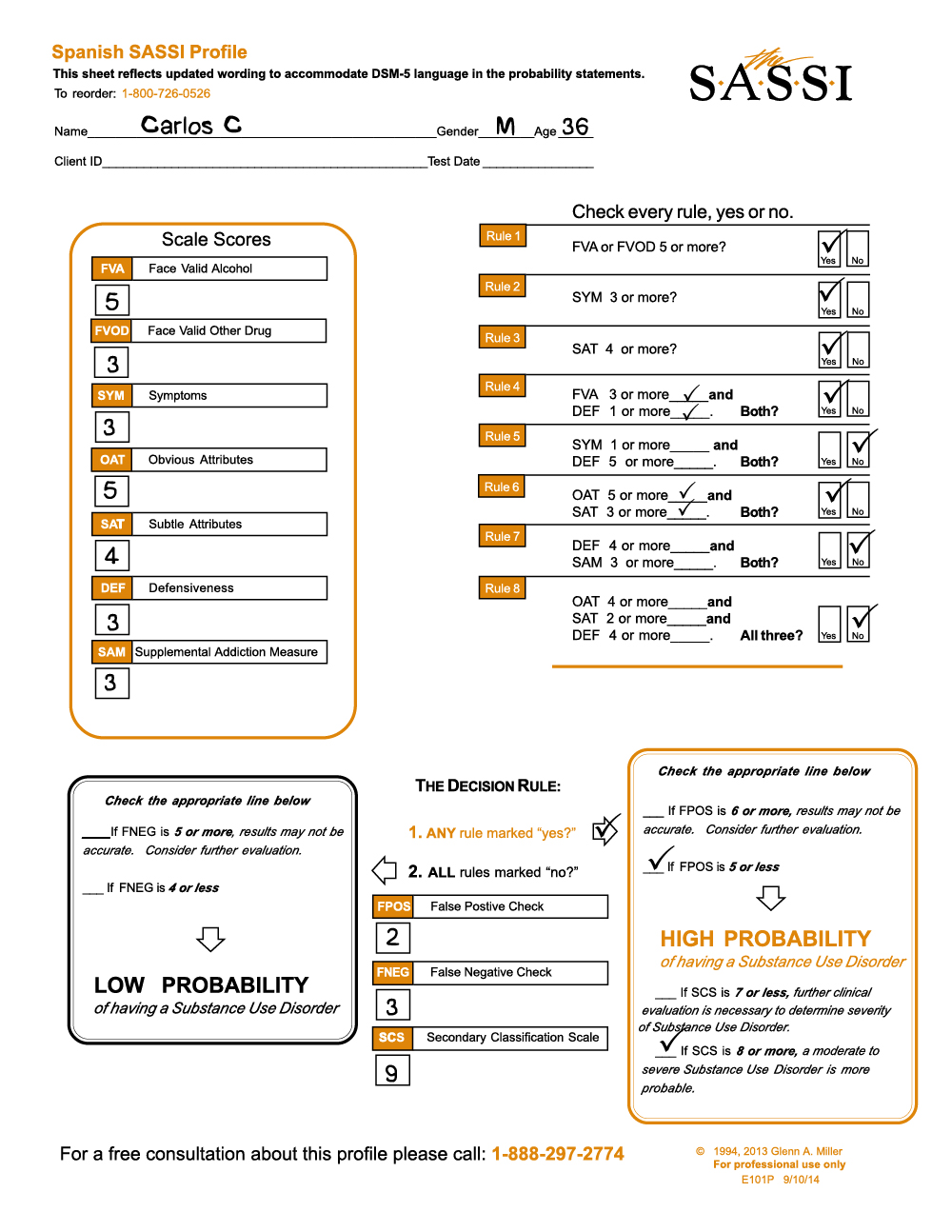
Carlos C. is a 36-year-old Mexican-American male who’s Spanish SASSI results indicate that he has a high probability of having a substance use disorder based on “yes” answers to Rules 1, 2, 3, 4 and 6 and because his FPOS score is 5 or less (FPOS=2). Validation studies indicate that 86% of the people who have substance use disorders are correctly classified by the Spanish SASSI based on the Decision Rule (High Probability) and the False Positive Check (5 or less).

In addition, Carlos has an SCS score of 8 or more (SCS=9) indicating that he is more likely to have a substance dependence disorder than substance abuse. In validation studies, the majority of people (77%) who are test positive on the Spanish SASSI and have SCS scores of 8 or more have a substance dependence disorder rather than substance abuse or no disorder.

The Administration and Scoring Instructions and Development and Validation of the Spanish SASSI provide detailed information on interpreting the Decision Rule results, the False Positive and False Negative Check (FPOS and FNEG) and the Supplementary Classification Scale (SCS).

Three of the Spanish SASSI scales, FVA, FVOD and SYM, are composed of “face valid” items that address substance misuse in an apparent or obvious manner. Some questions address inability to control usage. For example, on one of the FVA items, Carlos acknowledged that on several occasions he has had more to drink than he intended to. Other items on these scales reflect usage in order to better cope with negative feelings or other problems. Carlos, for example, reported on one of the SYM items that when he is anxious, he feels the need to drink. The face valid scales also include items that address negative consequences of substance misuse, such as physical, emotional and relationship problems. Carlos indicated on an FVA item that on several occasions his drinking has led to problems with friends and family members, and on a SYM item he acknowledged that he has had a drink first thing in the morning to steady his nerves or get rid of a hangover.

As you can see, by reading clients’ answers to specific questions on the FVA, FVOD, and SYM scales, it is possible to gain greater understanding of the types of problems they may be having with alcohol and other drug usage. Also, providing feedback to clients on the types of problems they have identified on the face valid items of the Spanish SASSI may be useful in the process of establishing treatment goals.

The remaining scales, OAT, SAT, DEF and SAM are subtle scales — i.e., the items that comprise these scales do not address substance misuse in an obvious or apparent manner. Therefore, Carlos’ responses to questions on those scales cannot be readily interpreted. The SASSI Institute provides guidelines for interpreting four similar scales as they appear on the English versions of the SASSI. However, the subtle scales on the Spanish SASSI are not identical to the English scales, and there is not enough information available to formulate guidelines for interpreting them for clinical purposes. The SASSI Institute, therefore, does not recommend interpreting scores on the subtle scales for clinical purposes. We will however, be delighted to help you with scoring or administering the questionnaire.

PDF Version Available for Download

A Message to Our Colleagues, Customers and Friends

We would like to take this opportunity to invite you, our many colleagues, to express your views, research findings and other developments within our SASSI Network blog. Our intent with this forum has always been to embrace the opinions and experiences of so many professionals and treatment providers throughout the country and indeed throughout the world. This forum is meant to be one of inclusion, not exclusion. All professionals from the multitude of addiction services provided have value and merit inclusion. These might focus on screening, testing, assessment, treatment, interventions, and others. We invite your submissions, and welcome your viewpoints. We feel this forum provides an opportunity to enrich us all with a collective wealth of knowledge that will ultimately enrich the addiction field. If you would like to contribute, please contact us at blog@sassi.com.

We hope that all of you and your families have managed to stay healthy during this tumultuous year. Our hearts go out to those that have experienced loss, suffering or pain during this Pandemic that has taken far so many lives. We remain hopeful that now that several vaccines are in distribution, and vaccinations are proceeding expeditiously, that we are nearing the close of this chapter in all our lives.

Please consider joining us by contributing your knowledge to our blog!

Interpreting the Results of an Adolescent SASSI-A3 with a High OAT Score

Happy New Year everyone!

I received my first Adolescent A-3 call on the helpline and was so excited and when I heard the numbers, I knew exactly why the clinician was calling.


As you look at the profile, you can see most of the numbers are within the norm. He meets Rule 6 so comes up with a High Probability of a Substance Use Disorder and no Prescription Drug Abuse.  So, what clinical information can the scale scores give you with so few scales outside the norm?

Although the FVOD is within the norm, it is above average and as recommended, you can do content analysis of his Face Valid scales. Another scale to pay attention to is the OAT score of 7 which is elevated. This suggests the client can acknowledge personal limitations and shortcomings and identify with other substance abusers. However, he may not want to or think he can change. The other significant score is SAT with a score of 1 which is below the 15th percentile. This suggests he may be hypersensitive to others and comes across as having a chip on his shoulder. This gives you good information on how to approach this client, especially when giving him feedback as you process the results with him because he is not giving you a whole lot of direct information regarding his use.

A word about the VAL of 6. If the numbers had resulted in a Low Probability of a Substance Use Disorder, you would question the results and do further investigation. Because he met Rule 6, there is no need to address the VAL. That said, with the VAL being so high, was this individual trying to manipulate the questionnaire and didn’t succeed?

Finally, users of the older version will notice that the SCS has been eliminated. This will require your use of the DSM-5 to determine the diagnosis and level of severity from your assessment.

Hope this information is instructive and assists you in your practice. And remember, as usual, we are here to help, so give the clinical line a call at 800-726-0526, press 2.

PDF Version Available for Download

New Publication!

The SASSI Institute is pleased to announce the publication of its newest manuscript “Mental Health and Substance Use Disorder Co-Morbidities Among Teens in Treatment: SASSI-A3 Correlations in Screening Scores.” Within this article, we review data from teenagers in treatment focusing on mental health diagnoses alongside a DSM-5 diagnosis of substance use disorder. Our hope is that by identifying possible correlations between SASSI-A3 scale scores and diagnosed mental health disorders, (depression and anxiety in particular), will provide clinicians with additional tools to direct the course of subsequent clinical interviews, in particular for teens suffering from co-occurring disorders. This Open-Access article is available here: Mental Health and Substance Use Disorder Co-Morbidities Among Teens in Treatment: SASSI-A3 Correlations in Screening Scores

Client’s High SAT Score Indicates Lack of Awareness

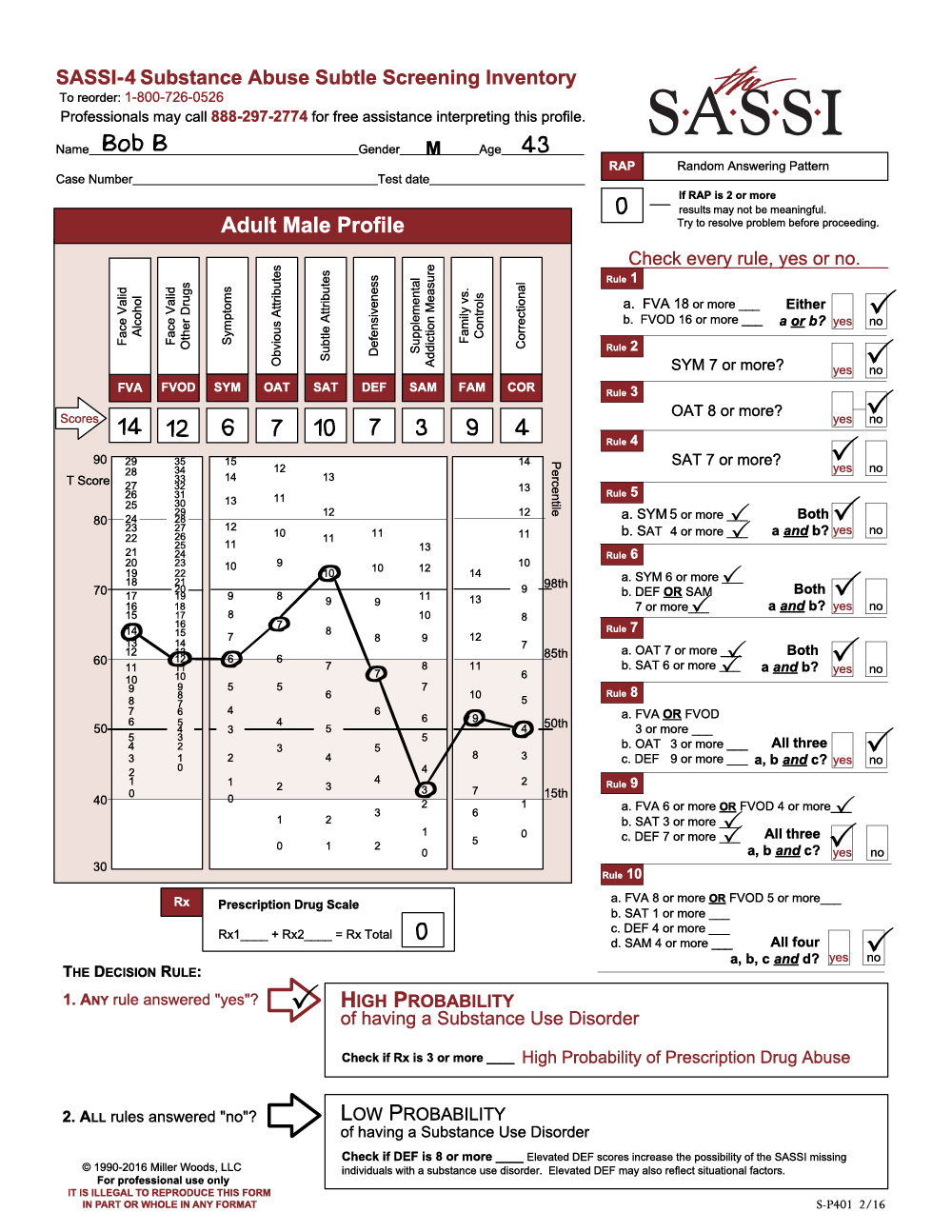
Bob is a 43-year old male who was referred by his attorney for a substance evaluation following a traffic fatality in which he was driving under the influence. Bob seems to have understood the items and responded in a meaningful way (RAP = 0). There is no significant evidence that Bob was defensive (DEF = 7).

The most salient feature of the profile is the significantly elevated SAT score, which is a key feature in both decision rules that lead to a test positive on the SASSI (Decision Rules 4, 5, 6, and 7). His responses were highly similar to substance dependent individuals regardless of their ability or willingness to report symptoms relevant to substance misuse. Given the lack of evidence of defensive responding, it’s likely that Bob falls in the category of those who are unaware of the full impact of substance use problems in their lives.

Individuals with this configuration of scores are often willing to acknowledge some behavioral problems related to their substance use. Bob demonstrates this by acknowledging significant current and/or past alcohol (FVA=14) and drug (FVOD=12) use. His pattern of responding also indicates some awareness of behavioral problems that are commonly associated with individuals with substance use disorders: low frustration tolerance, self-centeredness, grandiosity, etc. (OAT=7). However, given the elevated SAT, he will most likely not be able to make any connection between his acknowledged use and behavioral problems and their impact on other areas of his life.

He also responds in a fashion similar to individuals who live in an environment dominated by substance abuse (SYM=6). Although the SYM is not extremely elevated, it does tend to support the notion that Mr. B. may view his substance use as normal. Further content analysis may reveal additional factors about his life circumstances that might be important to consider in treatment planning.

Bob may be relatively well presented. He may also appear to be emotionally detached while maintaining a sense of pragmatism regarding his situation. Relatively poor insight and self-awareness are commonly present in these types of profiles. It’s not that Bob refuses to understand or is intentionally resistant; he literally doesn’t grasp that his substance use may be a problem that requires further exploration. In his mind, external factors or stressors may be to blame for his current predicament. The possibility that this tragic incident may be directly related to a substance use problem would be quite difficult for Bob to understand at this time.

PDF Version Available for Download

As 2020 Comes to a Close: A Message from the CEO

This year has been unusual in so many respects. Our resolves, faiths, and tenacities have been tested for over ten months now. We have suffered losses and multiple pains, including emotional, mental and physical. We have endured an almost constant barraging drain on our senses. For over two straight weeks now we have experienced more than 100K daily COVID-19 cases nationally. As a result, many of us have lost loved ones, friends, or colleagues. Many more have been unable to see our loved ones, but for the benefits of social media.

I for one, have been unable to see, hold, and hug my family for close to a year. I consider the risks too high to endanger myself and those I love any more than I have to. But I also know I am not alone and I know we are looking forward to a really great Holiday season next year; we will celebrate twice as hard in 2021. Various vaccines and antibody drugs are in development, and we should all be immensely grateful to all of the scientists, nurses, doctors, caregivers, and caretakers, that risk their lives daily in the hopes of developing something fast, and caring for the ill until we do.

Yet the truly amazing thing, what is truly astonishing is that despite these pains, throughout these arduous journeys, throughout these uncertainties, we have found the inner strength and fortitude to trudge on. A true testament to the human spirit. Through it all, we have managed to be there for one another, for our friends, colleagues, and for our families. We have remained united, and that should be foremost in all our minds.

In my humble opinion, in order to succeed and defeat this Pandemic in the end, it is in our best interests, indeed our civic duty to maintain our focus on what needs getting done. Let’s each do our part by adhering to the CDC’s policies and protocols. It also our fervent hope that at some point soon, the entire country is protected with enough COVID vaccinations that we successfully eradicate this Pandemic as we have historically done to other calamitous diseases in the past.

In the meantime, our staff, Board of Directors, and myself, offer you only the best for the coming year. Better times lie ahead!

Be kind to yourselves and let’s make it our mission to take care of each other, as best we can.

Happy Holidays!