While the core goal of identifying substance use disorders remains the same, the SASSI-4 (Adult) and SASSI-A3 (Adolescent) are tailored to the very different life stages and behavioral patterns of their respective groups.
Think of it this way: the way an adult hides a drinking problem is often very different from how a teenager masks drug use.
Comparison of SASSI-4 vs. SASSI-A3
Feature
SASSI-4 (Adult)
SASSI-A3 (Adolescent)
Age Range
18 years and older.
13 to 18 years.
Focus Area
Emphasizes long-term behavioral patterns.
Emphasizes family dynamics, peer pressure, and school behavior.
Subtle Items
Focuses on adult stressors like workplace issues and long-term social consequences.
Focuses on “acting out,” rebelliousness, and emotional regulation.
Key Differences in Approach
The Adolescent Version (SASSI-A3)
Teenagers are often in a state of natural rebellion or may be experimenting due to peer influence rather than chronic dependency. The A3 is specifically designed to:
Filter Peer Influence: It helps distinguish between a teen who is “experimenting” because of friends and one who has a burgeoning clinical dependency.
Assess Family Environment: It includes scales that look at the teens’ perception of their home life, which is a major factor in adolescent recovery.
Evaluate “Global” Functioning: It looks at how substance use is impacting their development (school performance, legal trouble, and social skills).
The Adult Version (SASSI-4)
Adults typically have more established defense mechanisms and more to lose (jobs, marriages, custody). The SASSI-4 was recently updated to better capture:
Prescription Medication Abuse: Since the opioid crisis, the adult version has been refined to better identify those misusing legal prescription medications.
Severity Markers: It provides more nuance on the intensity of the disorder, which helps in planning for long-term recovery versus short-term intervention.
Why the Distinction Matters
Using an adult test on a teenager (or vice versa) could possibly lead to inaccurate results. A teenager’s natural impulsivity might look like a “disorder” on an adult scale, while an adult’s more calculated “denial” might not be caught by a test designed for a more impulsive adolescent.
The purpose of the SASSI is to help identify people who are likely to have substance use disorders so that early intervention and treatment can be initiated when appropriate.
The Substance Abuse Subtle Screening Inventory (SASSI) is a widely used psychological screening tool designed to identify individuals with a high probability of having a Substance Use Disorder (SUD).
Its primary value lies in its ability to look past “denial.” Many people struggling with addiction may not be ready to admit it, or they might intentionally try to minimize their usage during an evaluation. The SASSI helps by being a bit more “clever” than a strictly face-valid questionnaire.
How It Specifically Helps
1. Identifying “Hidden” Issues
Unlike many tests that ask straightforward questions (e.g., “How many drinks do you have a week?”), the SASSI includes subtle items. These are questions that don’t seem related to substance use but are statistically linked to the behavioral patterns of people with SUDs. This helps clinicians identify people who are:
In deep denial.
Intentionally hiding their use.
Unaware that their behavior constitutes a disorder.
2. Providing a Faster Path to Treatment
Because the SASSI is relatively quick to administer and score, it acts as a “triage” tool. It allows counselors to quickly decide who needs an intensive clinical interview and who might just need basic education. This efficiency ensures that resources go to the people who need them most urgently.
3. Objective Data for Referrals
Objective scoring of the SASSI yields a screening outcome – a yes-or-no answer as to whether the client has a high probability of having a substance use disorder, as well as a check on validity of the profile, a score indicating level of defensive responding, and a score indicating the possibility of prescription drug abuse. For people involved in the legal system (like DUI cases) or workplace evaluations, having objective, validated results remove personal bias from the evaluator. It provides a foundation for recommending specific levels of care, such as:
Outpatient counseling.
Intensive Outpatient Programs (IOP).
Inpatient detoxification.
What the SASSI Is Not
It is important to remember that a high probability of a substance use disorder result on the SASSI is not a final diagnosis. A licensed professional must still conduct a full clinical interview to make an official diagnosis based on the DSM-5-TR.
Overall, the SASSI provides a useful tool for healthcare providers, substance abuse professionals, criminal justice entities and others who are involved in identifying and treating substance use disorders. It can help to ensure that individuals receive appropriate care and support, which can ultimately improve their health and well-being.
Identifies high or low probability of substance use disorders in adults 18 and older and includes a prescription drug scale that identifies individuals likely to be abusing prescription medications. It also provides a measure of profile validity and clinical insight into level of defensiveness and willingness to acknowledge experienced consequences of substance use disorder.
Identifies high or low probability of substance use disorders in adolescent clients ages 13-18. It also provides clinical insight into family and social risk factors, level of defensive responding, consequences of substance misuse teens endorsed, and a prescription drug abuse scale that identifies teens likely to be abusing prescription medication.
A Spanish language screening instrument empirically validated in clinical settings for use with Spanish-speaking adults from diverse ethnic backgrounds.
Identifies preintervention risk of future impaired driving, and changes in DUI-related risky behaviors & attitudes following intervention. Ideal for initial risk assessment, pre and posttest screening, and program evaluation.
We invite you to reach out to us for additional information and with any questions you may have at 800.726.0526. Training is available on all instruments.
Please join us for a free one-hour online SASSI Clinical Q&A session hosted by our Clinical Director, David Helton, LMSW, LCDC. Everyone is welcome to join us: those new to the SASSI, those considering implementation of the SASSI, or seasoned veterans of the SASSI. The Q&A is scheduled from 11 am – Noon ET on July 22nd. Save your spot by clicking here. Please share interesting profiles for David to discuss with the group by sending them (de-identified) via email any time prior to the session to scarlett@sassi.com. These profiles will help others learn about SASSI and offer insight into the various profile configurations. Note: Q&A sessions do not provide CEUs and are not a substitute for SASSI Training.
If you are interested in participating in a certified SASSI training, we will be hosting a Live SASSI Training webinar on the Administration & Scoring of the paper & pencil format of the SASSI as well as Clinical Interpretation on June 10th (Session 1) and June 24th (session 2). The sessions are $60 USD each and provide 3.5 CEUs. You can learn more and register by clicking here.
We wanted to let you know that we are still offering our free one-hour online Clinical Q&A sessions hosted by our Clinical Director, Kristin Kimmell, LCSW, LCAC.
We enjoy hearing how you are using the SASSI in your clinical practice and agencies as well as answering your questions. We currently have three more free Q&As coming up this year. You can reserve your spot and view available dates and times by clicking here. If you have profiles you would like to share with the group for discussion, please send them (de-identified) via email any time prior to the session to scarlett@sassi.com. Your contributions would be of great value.
Also, a reminder that we have a live certified SASSI training webinar on Administration & Scoring of the paper & pencil version of the SASSI on November 28th and Clinical Interpretation on December 5th. You can register by clicking here.
Note that the Q&A sessions do not provide CEUs and are not a substitute for SASSI Training. SASSI training provides 3.5 NAADAC CEs per session.
Overall, the SASSI can be a valuable tool for helping members of the LGBTQIA+ community by identifying and addressing substance use disorders. It can provide a standardized and sensitive way to screen for these issues and can help to ensure that individuals receive appropriate care and support based on their unique needs and experiences.
SASSI Online is our web-based platform that supports the digital administration of the Adult SASSI-4, Adolescent SASSI-A3, and Spanish SASSI. It provides a report with interpretive paragraphs outlining the decision rules and results from client responses. In this edition of SASSI Online Tips and Tricks we review the Dashboard Tabs, their functions and what the different Roles have access to.
All SASSI Online users have a Dashboard. When logged in to their account, they will see the text in the top right corner, text that reads: “Account Dashboard for [name on account]” Below is a description of each tab:
News – This space is used to provide updates from SASSI regarding research projects, questionnaire updates, and any other information specific to SASSI customers. Including these blog posts!
My Clients – This space is used to administer questionnaires, redeliver questionnaires, view reports, view completed questionnaires, and access the support materials page; this is where most of the work happens.
Admin Tab – This tab is only available to the Primary Clinical Contact (PCC). Here they can view client reports that counselors on their account have administered. The counselors cannot see the PCC’s clients, or those that belong to other counselors on their account.
Purchasing & Distribution – This tab is available to the Purchaser only. This space is used to purchase more questionnaires and manage distribution groups. Distribution groups are self-managing but can be customized to accommodate multiple counselors/users on an account who do not share a budget. The Purchaser can create Distribution Groups to add specific quantities of available SASSI questionnaires and add only the counselors/users that should have access to them.
My Account – This workspace will provide information about your account. If you are not the PCC and/or Purchaser, information about who is, is made available here. If you are the PCC, the list of registered counselors is found on this tab. All users can change their password and update account information and access their Customer ID. The PCC can also invite Counselors and Intake Staff to register.
If you are not currently using SASSI Online and would like to experience the features of the digital platform, create an account at www.sassionline.com. If you already have an account, let us know if you have any suggestions for our next edition of SASSI Online Tips and Tricks. As a bonus for reading this blog post to the end, reach out to us at blog@sassi.com, with the code phrase: Account Dashboard, to request two free SASSI Online administrations!
A recent caller wanted help in interpreting a profile completed by a 33-year-old male. He was instructed to complete the FVA/FVOD side of the questionnaire for the last 12 months. The administrator revealed during the call that the assessment was a pre-employment screening for the Department of Transportation. The helpline does receive regular calls from counselors who administer the SASSI-4 for the Department of Transportation after a driver has failed a drug or alcohol test for substances, but not for pre-employment screening.
In review, the client comes up with a high probability of a substance use disorder based on Rules 2,5,6 and 9. The RAP is 0 and the Rx Prescription Drug Scale is 0.
The FVA is below average use, the FVOD is on the 50th percentile. The SYM scale of 7 is above the 85th percentile, considered elevated and thus Rule 2 meets the criteria of a High Probability of a Substance Use Disorder. The rest of the scale scores are within the norm (between 15-85th percentiles) so clinically are not significant but are significant in meeting the criteria of a Substance Use Disorder if accounting for the additional rules of # 5, 6 and 9. The SAT of 5, being in the norm indicates the client was not in denial about his usage.
Considerations
Although the results do not account for current or actual use, further assessment may include urine screens that would give a more accurate representation of current use of substances. He does come up with a high probability of a Substance Use Disorder, so deeper inquiry is necessary.
The administration of this SASSI was part of a pre-employment screening and our position on the proper use of the SASSI in this regard, is very explicit:
From our User’s Guide and Manual: *
“The purpose of the SASSI is to help identify people who are likely to have substance use disorders so that early intervention and treatment can be initiated when appropriate.”
“To use the SASSI to discriminate against individuals violates the intent of the authors and may even violate the law.”
“SASSI results should not be used to abridge the rights of individuals or to disqualify applicants for positions, such as jobs or benefits, such as public assistance programs.”
Thus, it is extremely important to use the results in the most therapeutic way possible with the best intentions of helping individuals with a substance use disorder.
If you have any questions, please contact the Clinical Director, Kristin S. Kimmell, LCSW, LCAC at kristin@sassi.com.
*SASSI -4 User Guide & Manual – Chapter 1 (overview), pg.7 SASSI-4 Online User Guide – Proper Use of the SASSI. pg. 8
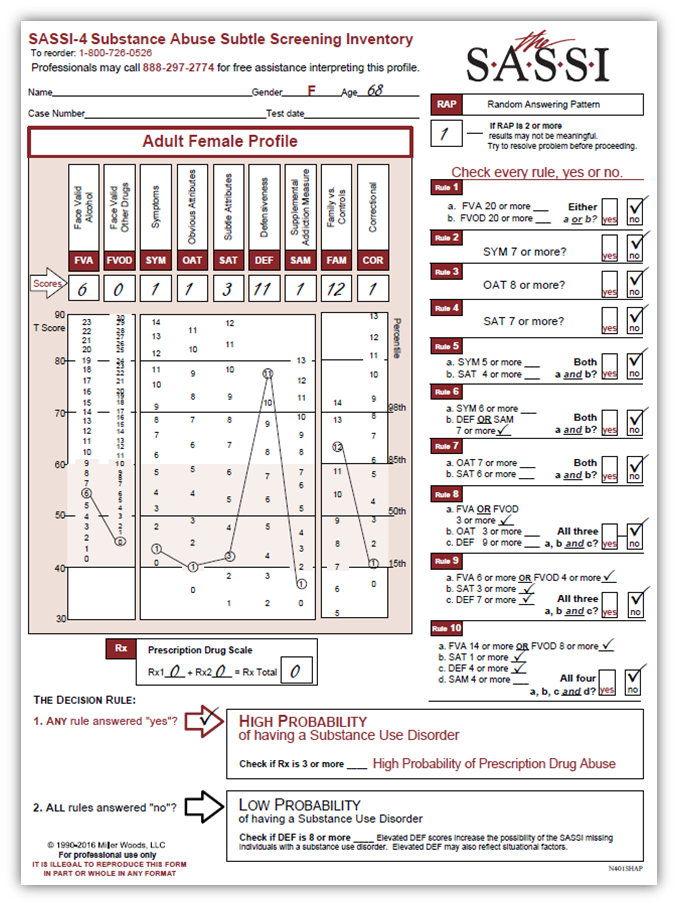
We frequently receive calls requesting clinical interpretation of profiles done on Department of Transportation (DOT) clients. These clients have failed their drug/alcohol screening and their license to drive has been suspended pending an evaluation. In this particular case, the client is a 68-year-old female whose alcohol level registered above the DOT threshold. Her SASSI result indicated a high probability of a substance use disorder based on Rule 9. As you see on the graph, most of the scale’s clinical results fall within the norm. DEF, at 11, is above the 98th percentile and FAM, at 12 is above the 85th percentile. The OAT score of 1 falls in the 15th percentile. The high-DEF score is not unusual in DOT evaluations. It is incumbent on the evaluator to determine what the defensiveness is about. The SAM scale is no help in this case because it is not elevated. An elevated DEF coupled with an elevated SAM indicates the defensiveness is related to substance use. The elevated FAM score indicates someone who is not comfortable looking at their own issues. And the low OAT score indicates someone who has difficulty acknowledging their personal limitations and shortcomings. The combination of these three scales provides information to the evaluator that most likely, this client is not going to be forthcoming in disclosing issues or problems. During the evaluation, another piece of information disclosed was the client’s admission of trying to manage or monitor her drinking to try to stay below DOT’s threshold of alcohol use. That certainly may be a red flag.
Since the SASSI is a screening inventory and does not diagnose, the evaluator needs to reference the DSM-5 to determine if, indeed, the client meets the criteria for a substance use disorder and if so, what level – mild, moderate, or severe. Based on that, the evaluator has a couple of options to consider. If possible, work individually or refer to an individual substance abuse counselor to establish rapport and work to get the defensiveness down. Motivational Interviewing is a good asset to pull out in this case. Another option is to refer her to an outpatient group setting with the goal of connecting her to other clients and also have access to individual counseling as well. Regardless, outpatient treatment seems to be the most likely intervention.
It would be helpful to acknowledge the financial impact on the client that suspension of driving privileges is having on her. That certainly could be triggering the extreme defensiveness we see in the results and the consequences for the client could be significant.
We hope these reviews are helpful and whether you are a new user or a very experienced one,
clinicians are here to help with any questions you might have. Clinicians are available M-F, 11-5 (EST). Call us at 800-726-0526 or 888-297-2774.
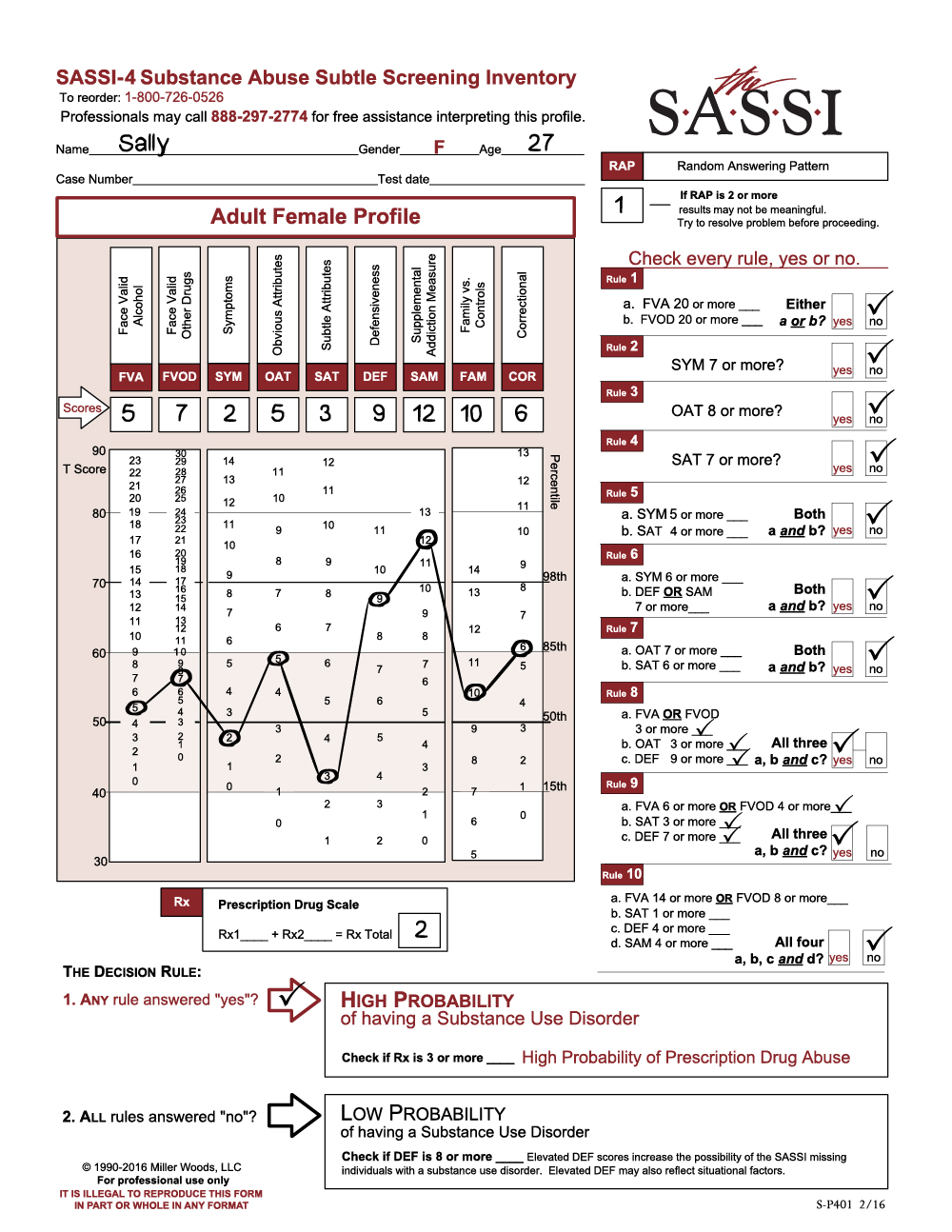
This sample profile is about a 27-year-old, Sally, who is a single mother of two small children. Sally was ordered by the court to report for a substance abuse assessment following an arrest for illegal possession of a controlled substance. Sally is also being investigated by the county’s Child Protective Services Agency, who has placed her children into foster care pending the outcome of the case.
An initial review of Sally’s scores indicates that, although she apparently understood the SASSI items and most likely responded in a meaningful way (RAP=1), there is evidence of significant defensive responding (DEF=9). Despite her defensiveness, the results indicate that she has a high probability of having a substance use disorder (SUD) based on Decision Rule 8 and 9. To put it another way, there is a 93% chance that Sally will meet the DSM-5 diagnostic criteria for having a substance use disorder once a more comprehensive evaluation is completed.
For now, however, the SASSI has provided us with important information concerning Sally’s illegal act; her behavior is likely to be related to a serious addiction problem. In this light, we can now shift to looking for additional features on her profile that might help us to understand Sally better and develop a more empathic point of view. Learning more about her perspective and how she is dealing with this entire process, including the new information from the SASSI, certainly is one way to provide supportive and effective care to her during a mandated process of evaluation.
A prominent aspect of Sally’s SASSI results reflects her similarity to people with SUDs who were instructed to conceal and minimize any evidence of their substance use problems (DEF=9, SAM=12). In addition, an elevated DEF coupled with an elevated SAM indicates her defensiveness is related to her substance use. One inference that can be drawn from this is that she is likely to have significant difficulty in disclosing personal information about her misuse of substances, as well as other problematic behaviors. Other SASSI scale scores may be reflecting this mind set. For example, she does acknowledge some misuse of alcohol and other drugs but no more so than the average person in the general population (FVA=5, FVOD=7). Her SYM score of 2 is also average, indicating no significant similarity to people with substance use disorders who do report experiencing many of the behaviors correlated with addictions. However, given that each of these scales is derived from face valid items that can be easily manipulated, it would be reasonable to suspect that Sally may be underreporting or misrepresenting problems in each of these areas.
It is easy to imagine that Sally may harbor some resentment towards the evaluation process and the practitioners involved. After all, she stands to lose not only her freedom but her two children as well. Underlying the overt anger and resistance may be an extreme sense of fear, apprehension and powerlessness in the face of feeling helpless to influence decisions that will undoubtedly affect the rest of Sally’s life. When viewed from her standpoint, it then becomes easy to see Sally’s defensiveness as a somewhat natural response to the threat she must be feeling. It’s no wonder that she is having difficulty acknowledging her substance use problems.
If further diagnostic evaluation for substance use disorder does indicate that Sally has an SUD, the following treatment approaches may prove useful based on insight gained from Sally’s SASSI scores. Despite Sally’s lack of ability and willingness to recognize the impact of her substance use on her life, it is our ethical responsibility as counselors to use our knowledge, skills and experience to lead her to an accurate understanding of the nature of her substance use disorder. This should be accomplished in a climate of respect and acknowledgement of the pressures that she is currently facing. An attitude of respect is particularly important when attempting to build a therapeutic alliance with clients like Sally that are mandated for assessment and treatment.
One way to engender open communication in a respectful way is to invite Sally to join you in a process of reviewing her responses on the SASSI face valid items. Acknowledging that it is important for you to understand her point of view, perhaps asking for further clarification or details as you actively listen is one way to cultivate trust and rapport. This communicates genuine concern and interest that may help Sally feel supported and empowered as she describes her experiences. Empathic responses that demonstrate a good understanding of the difficulties she is facing while helping her to gain insight regarding the nature of her substance use problems would be useful in making her an active partner in creating a treatment plan that she can accept.
Another effective way to increase Sally’s awareness of her substance use problems while maintaining a respectful relationship is to provide cognitively based educational programming. Didactic presentations of alcohol and drug information generally are viewed by clients as less threatening and often tend to elicit a more favorable response. Sally may particularly benefit from content that describes the impact of substance abuse on families and how, with proper treatment and aftercare, recovering individuals are often able to be reunited with their children and other family members.