
Tag: Subtle Screening

The Purpose & Potential of Assessment and the Role of SASSI Screening

Engaging in assessment regularly can make it become routine; therefore, sometimes perspective is lost and the purpose forgotten. Time needs to be taken to remember the precise questions assessments are trying to answer. When forgetting the specific reasons for conducting assessments, they lose their value ­ both to the individual client and the clinician.

Screening is an important part of assessment for the purpose of triage, identification of risk factors, and referral for additional services. The basic question is whether an individual is likely to have a particular problem. If so, the subsequent assessment and treatment plan should address that problem. Since screening tools are used to identify people who are likely to have a problem or be at risk for developing a problem, they are never infallible. The key element is to use a screening tool that meets the needs of the clinician. As an example, the crucial factor in airport security screening is that the procedure be highly sensitive; they do not want to miss anyone who is a security risk. ln other words, they do not want any false negatives. However, in eliminating all false negatives, the procedure that is used produces false positives and anyone carrying metal is flagged by the airport security screening and given some degree of further scrutiny, even though most people who carry metal are not found to be a security risk. But different screening settings have different needs. ln developing and maintaining the SASSI, the researchers recognized that there are costs associated with both over and under-identification of substance use disorders (SUD). Therefore, the research and development aims were directed toward maintaining a high level of sensitivity (few false negatives) and a high level of selectivity (few false positives).

While a relatively comprehensive assessment may be needed to arrive at a diagnosis, the basic question is whether the individual meets the specific criteria (e.g., DSM-5) necessary to arrive at a diagnosis. There exists a long-standing controversy regarding the value of diagnoses. Some argue that diagnoses serve to label people unnecessarily and others argue that it is important to do whatever possible to specify an individual’s problem in a reliable and meaningful manner to ensure appropriate treatment recommendations. Regardless, most agencies require clinicians to formulate a diagnosis, and diagnoses are needed for third party payments and as part of the admission criteria for many treatment programs.

Assessments are also needed for reports. Often individuals are referred by outside agencies (e.g., other health service providers, courts, employers, schools). In these instances, the clinician is placed in the position of providing expert opinion in what may be controversial or even litigious situations. It’s vital for the clinician to have a clear understanding of the precise request being made by the referral agency – What are the questions to be answered? What are the issues that are to be addressed? What types of opinions and recommendations are requested?

In conducting the assessment and writing the report, the clinician should be clear in differentiating observations from inferences and opinions. For example, if the only information on frequency and quantity of consumption of alcohol and other drugs is the individual’s self-report, the written report should indicate that the individual reports using a certain amount, not that the individual actually consumes that amount. If the clinician has cause for concern regarding a symptom of SUD, it should be phrased as a cause for concern rather than an observation. When using the SASSI to screen it becomes possible to make a statement to the effect that the individual’s pattern of responses suggests, with a known level of certainty, that the client is or is not likely to have an SUD. (Note: In addition to screening results, supplemental clinical information is required to meet the accepted standards for a DSM-5 clinical diagnosis of an SUD). The SASSI Rx scale can also help identify individuals likely to be abusing prescription medications and the other additional scales can provide clinical insight into level of defensiveness, consequences of use, desire for change, family and social risk factors, and acknowledgement of problems.

Always present information clearly and distinguish observation from inference and opinion. It is important to help the individual become increasingly invested in the treatment process. Assessment is a critical part of the treatment process and provides an opportunity for the clinician and the individual client to mutually identify problems, set goals, and devise strategies to meet those goals. The individual client is the primary focus, and the information that’s gathered is useful to these individuals only to the extent that it helps them take action that enhances their quality of life. For information on interpreting SASSI scales, please consider completing our Clinical Interpretation training. Registration information can be found at https://sassi.com/sassi-training/.  Also, professionals can call our free clinical helpline at 800.726.0526 Option 2, M-F 1-5pm ET for help with profile interpretation.
High Probability by Subtle Scales Only

Many people know that the SASSI is possibly the best substance use disorder screening tool that exists in the behavioral health field today. The instrument can be easily administered in 15 minutes or less and manually scored in less than two minutes (or scored automatically in the online web-based version), resulting in an objective empirically-based statement of the likelihood of the client having a substance use disorder with an overall accuracy of 92% for adults and 89% for adolescents. And it achieves this kind of accuracy even in clients who are unwilling or unable to acknowledge their substance misuse or the symptoms associated with it!

Through extensive case study research, the SASSI has been found to be able to provide even more utility to clinicians in the form of clinical interpretations that go beyond just the high or low probability of a substance use disorder result. In addition to interpretations of individual scale raw scores that fall outside the boundaries of the research-based established normal distribution, we also have discovered some trends or characteristics in the specific situation in which the client scores as high probability of a substance use disorder based on SASSI decision rules that involve only subtle scales rather than face valid scales. That is the subject of our blog today.

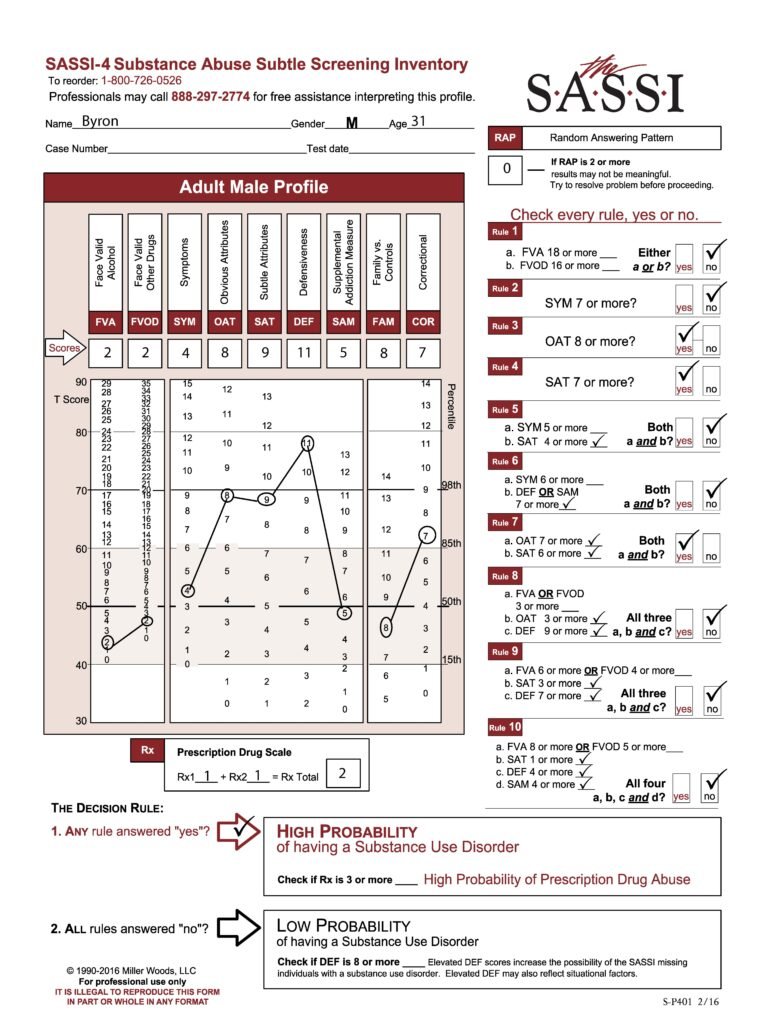
The SASSI is made up of both face-valid scales and subtle scales. Face-valid scales such as FVA, FVOD and SYM are scales that are very obvious about what they are measuring, while subtle scales such as OAT, SAT and DEF are made up of items that do not seem to have anything at all to do with substance use. Our case study analysis showed that certain behaviors, characteristics or patterns emerge in individuals who score as high probability based only on subtle scales. Let’s take a look at an example. Byron is a 31-year-old male who was asked to be evaluated because of a child custody battle in which the mother alleges that Byron misuses drugs. Byron has not yet had a comprehensive assessment done, but has so far only admitted to some occasional use of marijuana. A SASSI was administered and the results showed that Byron met the criteria for Decision Rules 3, 4 and 7. Each of these decision rules involve only subtle scales and no face-valid scales. So, what characteristics do we tend to find in individuals with this type of scoring pattern?

One key feature of this type of scoring pattern is the fact that these individuals often have very little insight into the pervasive nature of the addictive disorder in their lives. Most of the time, this type of client actually has a very sincere delusion regarding their substance misuse. In other words, they are not trying to trick you into thinking they do not have a problem with substances; they simply do not see it. Often, every single activity this person is engaged in and every decision they make somehow involves substance use. Often, the substance misuse has become an unhealthy way to cope with emotions that are too overwhelming and so individuals with this type of scoring pattern are very emotionally avoidant. Many times, this individual has difficulty admitting their weaknesses or the personal limitations with which they struggle and instead choose to focus on very superficial things, ignoring the depth of the substance problem in their life. We can see these types of traits and behavior patterns manifested in this client’s individual face-valid scale scores such as lower than average (T-score of 50 is the mean) FVA and FVOD scores and only an average SYM score. These all indicate a client who does not acknowledge or admit to having any significant problems or negative consequences as a result of substance use. The client’s extremely high DEF score indicates a very high level of guardedness and the desire to be seen as having no weaknesses or faults. It’s even possible that the FVA, FVOD and/or SYM scale scores could be artificially low because of minimization of symptoms in the client’s answering patterns on these scales fueled by this defensiveness. However, as mentioned previously, it’s possible and even probable that this client really has very little insight into his problem with substance misuse and so he may be unable to even recognize the obvious negative consequences he is experiencing. This is especially typical of clients with high SAT scale scores as this client has. While this client does also have an equally high OAT score, which often indicates some ability to recognize negative attributes that are common in individuals with substance problems such as impulsiveness, self-pity, resentment, and impatience, it is more likely in this case that the client does not see these issues as having any relationship to his misuse of substances.

At this point, a comprehensive assessment needs to be done along with a formal diagnosis and possible treatment plan formulated. Since the SASSI does not provide an actual diagnosis and does not, by itself, indicate a need for treatment or the level of treatment, it is important to gather more information such as self-reports of the client’s current usage patterns, collateral reports, naturally occurring records, behavioral records, etc. to determine a diagnosis and course of action. Typically, clients with this scoring pattern do have a significant substance use disorder and many of them, if they need treatment, will often need a relatively intensive level of treatment which includes individual and group therapy sessions; more than just cognitive/educational programming. However, individuals with this type of scoring pattern will often be initially resistant to any treatment as they honestly do not see a problem that needs to be treated. The high level of defensiveness will require lots of time spent in developing a therapeutic alliance and positive rapport, affirming and supporting him throughout the process. Clients like this are often a high relapse risk and so it is important to provide wraparound supports and a level of intensity in the treatment regimen which allows for quicker and stronger intervention in the event the client attempts to relapse. Individuals who score as high probability of a SUD based only on subtle scales are often some of the most challenging clients, but with information gained from the client’s scoring patterns on the SASSI combined with additional information from other sources, you are in a better position to know what to address to increase the possibility of success with this client.

Don’t forget that full training on administering/scoring the SASSI and clinical interpretation of the sub-scales is available. Check out https://sassi.com/sassi-training/ to register for an upcoming training. Also, our free Clinical Helpline is available M-F from 1:00pm to 5:00pm EST to answer any questions you have about the SASSI.

PDF Version Available for Download

Help Us Shape the Future of SASSI Online

At The SASSI Institute, our mission has always been to provide you with tools that make your work easier, more accurate, and more effective. SASSI Online has grown into an important resource for clinicians, educators, and professionals in the field of substance use screening — and that growth is thanks to the support and feedback of our valued customers.

Now, we’d like to hear directly from you.

What features would make SASSI Online even more useful in your daily work?

  • Are there tools or functions that could save you time?
  • Are there any enhancements to reporting, data management, or integrations that would make your workflow smoother?
  • Is there something you’ve always wished SASSI Online could do?

No suggestion is too small or too big. Whether it’s a streamlined way to organize client assessments, a new type of dashboard, or a feature you’ve seen in other platforms that you’d love to have here—we want to know.

Your input will help guide our development team as we continue to improve SASSI Online and ensure it remains a tool that truly supports your practice.

👉 Please share your ideas with us by clicking here.

Thank you for being part of the SASSI community and for helping us shape the future of SASSI Online!

The Value of the SASSI in University Counseling Centers

1. Benefits

  • Early identification: The SASSI’s screening tools (the SASSI) can help identify students who may be struggling with substance use disorders, even if they are not openly acknowledging the issue.
  • Targeted interventions: The SASSI can provide valuable insights for tailoring interventions and treatment plans to individual student needs.
  • Reduced stigma: The SASSI is a tool for understanding and supporting students, rather than a judgmental “test.” 

2. Training and education

  • Accessible training: We offer workshops and webinars (live or recorded) for counseling center staff on the proper administration, scoring, and interpretation of the SASSI.
  • Free resources: Staff can utilize our free clinical helpline and free clinical Q&A webinars to address questions and concerns related to using the SASSI.
  • Collaboration with academic programs: We welcome partnerships with university departments to integrate SASSI training into relevant courses (e.g., counseling, social work, psychology). 

3. How to integrate SASSI into existing practices

  • Part of intake: Incorporate the SASSI as a routine part of the intake process for all students seeking counseling services.
  • Utilize online options: Online administration is convenient and SASSI Online can be used for telehealth and remote screening, including increased accessibility, client comfort, immediate results, and streamlined record-keeping.
  • Referral protocols: Clear protocols for referring students based on their SASSI results to appropriate internal or external resources, including addiction counseling,  or specialized treatment programs can be developed. 

By implementing these strategies, University Counseling Centers can effectively use the SASSI and provide crucial support to students struggling with substance use concerns. 

Use of The SASSI in Identifying Factors in Crime and Criminal Recidivism

Although there have been ample demonstrations of the value of rehabilitation programs for criminal offenders, it is important to recognize that recidivism in the criminal justice system remains a serious problem.

It would be an easy matter to greatly reduce the incarcerated population if one and only one factor caused people to have multiple arrests. Substance Use Disorder (SUD) is a strong common element among repeat offenders. However, there are numerous other factors that can also lead to habitual legal offensives – impulse control problems, personality disorders, psychiatric disorders, cognitive impairment, chronic stress, a history of trauma, childhood and other developmental issues, peer culture, poor social skills, etc.

No single factor necessarily causes criminality, but each one can contribute to a tendency toward law violation, and they can combine to produce a high-risk profile. Because there are multiple causes of criminality, one treatment program may be of value for some repeat offenders but still does not address all the issues that need to be addressed to prevent further legal difficulties. Repeat offenders do not come from one mold. Therefore, one given course of treatment is not likely to be maximally effective for all recidivists.

Screening to Identify Risk

The challenge of early intervention is to find a means of identifying and addressing risk. A first step in reducing recidivism in the criminal justice system is to screen legal offenders to identify individuals who are at greatest risk for ongoing legal difficulties and who are likely to have an SUD to provide them with appropriate and timely treatment.

SUD is strongly related to legal problems. Using SASSI screening tools can provide information on ongoing legal problems that can be helpful in treatment planning. Since there are multiple causes of habitual offending, instruments that measure a single factor are not likely to be effective in early identification of high-risk individuals. The SASSI Correctional (COR) Scale identifies individuals with a history of legal problems. While it is unclear why the COR items identify these individuals, there are many possible factors to explore, including: impulse control, anger management, high risk-taking, not responsive to consequences of behavior, low frustration tolerance, and poor social skills.

Effective Screening

Screening is a first step; but a vital and cost-effective first step, particularly in settings that process large numbers of clients. After identifying high-risk individuals, it is important to gather information that is useful in developing a treatment plan.

Client-Appropriate Treatment

There is real value in gathering information that is directly useful in planning therapeutic interventions that will address the client’s specific needs. When screening and assessment are conducted with the intent to help the professional join the client in setting effective treatment goals and planning how to achieve them, the screening and assessment becomes a vital part of the treatment process. It is important to use tools that are accurate and provide clinically useful information.

Despite the overall effectiveness of SUD treatment and despite the demonstrated cost-effectiveness or providing treatment as part of society’s response to criminality, rehabilitative diversionary programs are not maximally effective in reducing rates or recidivism. Part of the solution lies in developing interventions that are sensitive to subgroup differences and individuals’ needs. Individuals with SUD differ from one another. They therefore respond differently to different types of treatment.

Matching treatment on the basis or the nature and degree of the client’s psychopathology and sociopathy increases the effectiveness of the treatment. While it may not be possible to fulfill all the mandates, if we wish to reduce recidivism within the criminal justice system, it is necessary to identify the individuals most at risk, determine their treatment needs, and provide treatment tailored to those needs. The SASSI screening tools can be a very helpful first step in that direction.

The SASSI as a Cost-Effective Screening Tool in Criminal Justice Programs

Working with mandated clients can be challenging. Mandates are in place with goals to reduce crime, decrease recidivism in the criminal judicial system, lower the prison population, and cut back on substance use and addiction.

These are all great goals; however, achieving them can be more difficult than proclaiming them. Professionals in the fields of health care,criminal justice. and other social services are given the charge of executing the mandates and bringing the goals to fruition.

Addiction is a serious and widespread health problem: it has a devastating impact on individuals, their significant others, and society. As a health care problem, substance use disorder (SUD) is tied to issues in criminal justice. One of the common consequences of SUD is legal difficulties.

Money, a central issue underlying all mandates, is certainly a complex issue in SUD treatment. It costs money to treat SUD, but it costs more not to treat individuals suffering from them. With so many cutbacks and rising costs, professionals have been asked to do more with less. We are asked to balance the complex and often contradictory needs of our clients, referral sources, funding agencies, boards of directors, and society.

SUD treatment is intimately tied to the criminal justice system. Many of us work directly within the criminal justice system, and many more of us serve clients who are referred by colleagues from courts and correctional programs. There is an expectation that our services will address the mandates. We are expected to rehabilitate individuals, cut back on drug abuse, reduce crime, lower jail populations, and be cost-effective. We are expected to do more, do it better, and do it all with fewer resources. One way to cut back costs is by conducting early interventions. The SASSI screening tools help address the challenge of early intervention by providing a means of identifying and addressing risk. A first step in reducing recidivism in the criminal justice system is to screen legal offenders to identify individuals who are at greatest risk for ongoing legal difficulties and who are likely to have an SUD to provide them with appropriate and timely treatment.

A Common Element in Domestic Violence: Substance Misuse

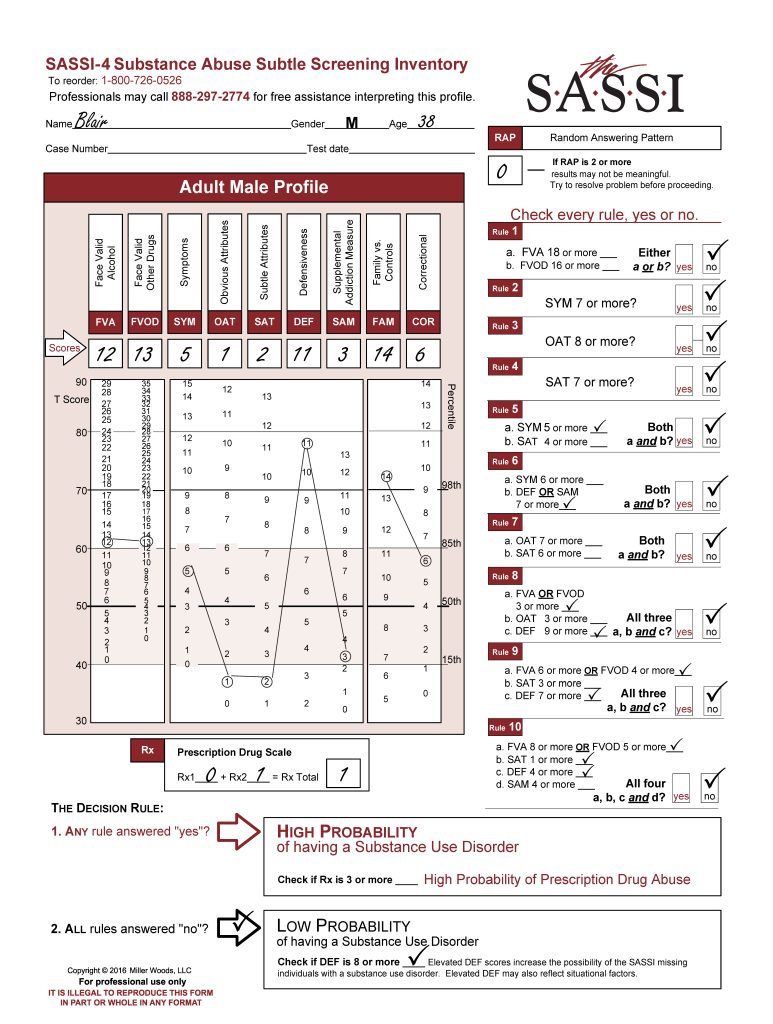
The following profile is for a 38-year-old male, “Blair,” who has been mandated to counseling following an instance of spousal abuse. First, note that the scale scores do not meet the criteria for classifying Blair as High Probability of having a substance use disorder (SUD).  However, the Face-Valid Alcohol (FVA-12) and Face-Valid Other Drugs (FVOD-13) scores are moderately elevated above the mean (50th percentile) since they are more than one standard deviation from the mean and above the 85th percentile. It is important to recognize that FVA and FVOD are not just measures of frequency and quantity of consumption. Rather, they are mostly measures indicating acknowledgement of significant negative consequences as a result of substance misuse, as well as possible loss of control and using as a coping mechanism. Thus, even moderately elevated scores that do not in and of themselves lead to classifying the person as high probability of having a SUD are often indicative of some level of substance misuse. It is important to investigate this further. We not only want to establish whether substance misuse is a current or past pattern of use, but (in the context of this client’s reason for referral) further investigation is also needed to determine more about the relationship between physical abuse and substance misuse in this client’s life.

Note that the Obvious Attributes (OAT-1) score is low, i.e. it is below T40 where less than 15% of the normative sample typically scores. This type of OAT score suggests that Blair does not acknowledge the typical negative attributes or behaviors commonly associated with substance misusers such as impulse control problems, low frustration tolerance, impatience, a tendency to hold grudges, etc. An OAT score this low suggests it is not simply that he does not perceive himself as engaging in such behaviors, but that he actively (consciously or unconsciously) distances himself from any hint that he has such tendencies. In other words, he finds it difficult to acknowledge common weaknesses, personal limitations or human foibles and certainly does not see himself as being in any way similar to those who have substance problems. Often, people who come from homes that were dominated by abuse, substance misuse, or other problems are motivated to see themselves as not being like the primary abuser in their family of origin. His very elevated FAM score (FAM-14) and to some extent his somewhat elevated SYM (SYM-5) score suggest that he may have lived in an environment affected by substance misuse.

The Subtle Attributes (SAT-2) score is also significantly below average, and this can often indicate a person who may exhibit strong feelings of hypersensitivity to what others think of him stemming from his perception that others frequently reject him and unfairly judge and criticize him. This score suggests that Blair may be highly attuned to others’ opinions and may perceive slights or criticism, even when none are intended. 

The Defensiveness score (DEF-11) is very significantly elevated. This often indicates someone who has their guard up and answers the questions by endorsing only things that may make them look more positive. This is not particularly abnormal in cases like Blair’s where there are situational factors putting him at risk of losing something important to him. Since Blair is being evaluated following an accusation that he beat his spouse, he is naturally on guard. The defensiveness could also reflect a more general tendency to avoid seeing and acknowledging any personal limitations or weaknesses and is somewhat confirmed by his very low OAT score as discussed earlier. Regardless of the cause, it is important to recognize that Blair probably approached the screening process in a defensive manner and because of this there is also a higher-than-normal possibility of a false negative and potentially a possibility that Blair minimized some of his symptoms of misuse on the more face valid scales such as the FVA, FVOD and SYM.

As mentioned earlier, Blair’s score on the Family vs. Controls (FAM-14) scale is significantly elevated. The FAM scale is composed of items that tend to identify individuals who may have been involved in a family of origin in which there was significant substance misuse. People who have high FAM scores often may obsessively focus on the needs and feelings of others. It is therefore interesting to contemplate how a high FAM score might fit as a characteristic of a perpetrator of domestic violence since spousal abusers are not generally thought of as “caretakers.” The crucial element may be the tendency of individuals who score high on the FAM scale to base their happiness and their sense of well-being on the behavior of others, leading to a need to control. Violence can be an extreme expression of a profound need to control.

Based on his SASSI scores, the Decision Rules result indicates a low probability of Blair being diagnosed as having a SUD. However, the significantly elevated DEF score cautions that there is an increased possibility of a false negative result (i.e. test-miss). His FVA and FVOD scores, while not high enough by themselves to provide a “high probability of a SUD” result, were clear indicators of acknowledged negative consequences from misuse of substances. Given the fact that many people with DEF scores as high as Blair’s often minimize some or a lot on the face valid scales to make themselves look better, there is still a possibility that Blair may suffer from a substance use disorder. Substance misuse is a common ingredient in domestic violence.

Domestic abusers often do not assume responsibility for their behavior, claiming that the victim “made me do it.” Blair’s SASSI profile corroborates and expands on this. The low SAT score suggests that Blair may have this victim mentality, and the low OAT score suggests that he is indisposed to see in himself the very tendencies that are likely to lead to spousal abuse such as low frustration tolerance, poor impulse control, anger management problems, a tendency to hold grudges, etc. The high-DEF score suggests a broader proclivity not to acknowledge personal limitations and to only endorse positives; and an extreme focus on others, as suggested by the high FAM score, could lead to an inability to deal effectively with interpersonal conflict. Ongoing comprehensive assessment should be directed toward determining more precisely the role of substance misuse in Blair’s spousal abuse. Treatment should also be directed toward helping Blair perceive and act in accord with appropriate personal boundaries. He is likely to need help in learning to accept and deal with interpersonal conflict and to assume greater responsibility for his behavior. As it stands, his extreme need to control others may lead to poor social judgment that allows him to construe violent acts as mature behavior and provides him with a rationale for excusing the inexcusable.

We hope you find this useful information regarding clinical issues. As always, the Clinical Helpline at 888-297-2774 is open to serve you Monday through Friday, 1 pm to 5 pm (EST).

PDF Version Available for Download

SASSI Instruments

The SASSI Institute offers the following brief and easily administered psychological questionnaires:

SASSI-4 | Adult Substance Abuse Subtle Screening Inventory-4

Identifies high or low probability of substance use disorders in adults 18 and older and includes a prescription drug scale that identifies individuals likely to be abusing prescription medications. It also provides a measure of profile validity and clinical insight into level of defensiveness and willingness to acknowledge experienced consequences of substance use disorder.

SASSI-A3 | Adolescent Substance Abuse Subtle Screening Inventory-A3

Identifies high or low probability of substance use disorders in adolescent clients ages 13-18. It also provides clinical insight into family and social risk factors, level of defensive responding, consequences of substance misuse teens endorsed, and a prescription drug abuse scale that identifies teens likely to be abusing prescription medication.

Spanish SASSI | Spanish Substance Abuse Subtle Screening Inventory

A Spanish language screening instrument empirically validated in clinical settings for use with Spanish-speaking adults from diverse ethnic backgrounds.

BADDS| Behaviors & Attitudes Drinking & Driving Scale

Identifies preintervention risk of future impaired driving, and changes in DUI-related risky behaviors & attitudes following intervention. Ideal for initial risk assessment, pre and posttest screening, and program evaluation.

We invite you to reach out to us for additional information and with any questions you may have at 800.726.0526. Training is available on all instruments.

Youths As Role Models

We previously had a wonderful team member, Marlene K. Brooks (1940-2016), who began work at the Institute in 1993 before retiring to Florida in 2005. During that time, she assisted in the development of the Adolescent SASSI-A2 as Executive Assistant and Editor. When the 2nd iteration was released, Marlene gave a thank you to all the professionals who are involved with helping youth make positive choices and she shared the following personal story which demonstrates how teens can be role models for other teens and adults alike. We thought those of you who missed it would find value in being reminded that you do make a difference in the lives of youths through education, prevention, and early intervention.

My Granddaughter, My Role Model

My oldest grandchild, Kara, entered the 9th grade this year, her first year of high school. Kara is beautiful – inside and out – a wholesome, healthy 14-year-old, who doesn’t try to look or act older than her years. An honor student, she takes her schoolwork and other responsibilities seriously. She is praised by her teachers and has always been a source of pride to our family.

But Kara has always been something of a “home-body,” and by choice, has sheltered herself somewhat from the “real world.” Therefore, I was concerned for her this year, fearful that she may be a bit naïve and have difficulty when confronted with the types of issues that surely would arise in a large South Florida high school. None of us realized the strength of character this seemingly shy young girl possessed.

During the summer, Kara was invited to a slumber party given by a friend she liked and so accepted that particular invitation. Not long after she arrived at the party, she called her parents to come and pick her up. They didn’t question why but immediately drove over to get her. On the way home, she explained that two girls had come to the party and were smoking pot, and she promptly announced that she was leaving. She told her mom and dad that she knew everyone was going to be mad at her, but she didn’t care. The next day the girl hosting the party called and told Kara that after she had gone home, the others asked the two girls to leave. We all told her how proud we were of her for setting such a wonderful example, but that wasn’t the end. She called me one evening, and of course I asked how school was going. She said she loved it, had made all A’s and one B, and was excited to be going to her first football game the next night. And then she said, “Guess who I ran into that just started going to our school – one of the girls who was smoking pot at the party. She looked different – “nicer” – and she came up to me and told me that she wasn’t doing the things she used to do anymore, and that it was because of me! And Kara kiddingly said to her “Do you mean I’m your role model?!”

I searched what’s left of my memory, trying to think of a time when I was as courageous and outspoken among my peers about “doing the right thing” as Kara had been. I think that we as adults have become so preoccupied with being “politically correct” that we hesitate to reveal our own convictions – not that we should ever offend, but we should be able to take a stand against those behaviors that we believe in our hearts to be wrong or harmful. Kara took a stand, despite feeling that she may become “unpopular.” As it turned out, she earned not only the respect of her elders but that of her peers. Her classmates now call her “the Prude” and nominated her for Prom Queen.

What better role model could a grandmother have!

Originally published in the SASSI News & Reports Volume 9, Number 2, Dec. 2001, print edition.

Help Us Shape the Future of SASSI Online

At The SASSI Institute, our mission has always been to provide you with tools that make your work easier, more accurate, and more effective. SASSI Online has grown into an important resource for clinicians, educators, and professionals in the field of substance use screening — and that growth is thanks to the support and feedback of our valued customers.

Now, we’d like to hear directly from you.

What features would make SASSI Online even more useful in your daily work?

  • Are there tools or functions that could save you time?
  • Are there any enhancements to reporting, data management, or integrations that would make your workflow smoother?
  • Is there something you’ve always wished SASSI Online could do?

No suggestion is too small or too big. Whether it’s a streamlined way to organize client assessments, a new type of dashboard, or a feature you’ve seen in other platforms that you’d love to have here—we want to know.

Your input will help guide our development team as we continue to improve SASSI Online and ensure it remains a tool that truly supports your practice.

👉 Please share your ideas with us by clicking here.

Thank you for being part of the SASSI community and for helping us shape the future of SASSI Online!