
One question we field often on the clinical helpline is what does it mean when either the OAT (Obvious Attributes) is higher than the SAT (Subtle Attributes) or when the SAT is higher than the OAT when both are elevated above the 85th percentile?
Tag: SASSI-4
A SASSI-4 Profile Analysis: Prescription Drug Abuse
A caller requested help interpreting the result of a SASSI-4 questionnaire on a male client who presented himself as having an opioid addiction.
‘Curtis’ is a 36-year-old married man. He and his wife have no children. He works as a landscaper which he describes as physically very demanding. His parents smoked marijuana while he was growing up and Curtis also smokes marijuana. His older brother died ten years ago, and Curtis is still grieving. His brother also had substance use issues. Curtis also may have a history of being molested as a child which he does not remember, but his brother relayed that they were both molested by a babysitter.
Curtis reports a four-year history of opioid addiction which started as a result of a herniated disc in his back. He was initially prescribed hydrocodone for pain. He tried to quit once three years ago. Currently, he is ordering “stuff off the internet” or getting oxycontin from friends. He has been taking 180 mg/day with a maximum of 240 mg per day. It takes 150 mg. for him not to get “sick.” Curtis continues to smoke marijuana on the weekends about one time per week. He has a legal history of possession of marijuana in 2004 and attended an outpatient treatment program doing “what I had to do.”
He has been slowly tapering off the opioids for the past five weeks and currently is down to 80 mg/day. His goal is to completely get off the opioids but he is not interested in residential treatment at this time because it is his busiest time of year. Although he has attended NA, he does not like it. Curtis is more drawn to Smart Recovery.
The SASSI-4 was administered for lifetime use on the face valid side of the questionnaire.
What were his SASSI-4 results? Curtis has a ‘High Probability of having a Substance Use Disorder’ and a ‘High Probability of Prescription Drug Abuse.’
This looks like a straightforward profile on the face of it. His score of 42 on the FVOD and 18 on the SYM indicate someone who is very open concerning his drug use, and because these are face valid scales, content analysis could provide useful information to further explore with the client.
The OAT score of 6 is right at the 85th percentile. The client may be able to identify with some of the characteristics of substance users such as impatience, resentment, self-pity and impulsiveness. However, the SAT score of 8 is higher than the OAT and may blunt the ability for Curtis to have insight into his behavior. When the SAT is higher than the OAT, the client may exhibit a lack of awareness or simply denial around the impact drugs are having on his life. In this case and not unusual, opioid users do not see themselves as “typical” addicts. That may account for the OAT score.
The DEF score of 2 can be a ‘red-flag’ as it is below the 15th percentile. A score this low can indicate someone with poor ego strength, feeling helpless and hopeless and may be exhibiting symptoms that look like depression. The clinician may want to do a mental health screening or refer the client for screening.
The FAM score of 5 is also very low, below the 15th percentile. This can indicate the client is focused on himself and not that concerned about others. This does not indicate a personality disorder but given the client’s circumstances, makes sense that he would be more internally focused.
The COR score of 8 is elevated above the 85th percentile. He has answered in a similar way to people who have had legal issues for any reason. We suggest screening for those behaviors or characteristics we often see in that population. These can range from poor social skills, low frustration tolerance, risk-taking behaviors, anger management issues or impulse control issues. These issues could be impacting on Curtis’s choice-making abilities.
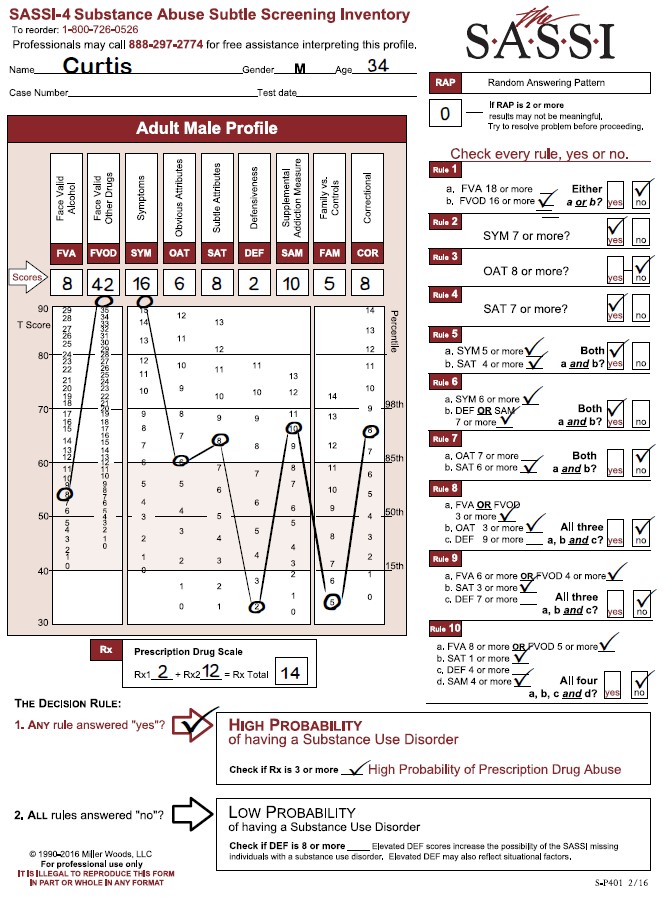
Finally, looking at the Prescription Drug Scale. With the score of 14, it is quite clear that he is identifying behaviors associated with prescription drug abuse. Again, as a face valid scale, looking at these individual items will generate a lot of information for the clinician. The clinician will need to look at treatment readiness, discuss medication needs, possible referral and other reported clinical issues.
A SASSI-4 Profile Analysis: Context Matters
If you have attended one of our trainings either in-person or online, you know the section on how to administer the SASSI to a client is one of the most important. A thoughtful approach can set the tone for the entire assessment by helping a client feel more at ease and engaged in the treatment process. We emphasize the importance of first establishing rapport with the client. The questionnaire is presented as an aid, not a test with right or wrong answers. We instruct to administer the true/false side first, then checking the appropriate time frame for the face valid side. Letting the client know s/he will have a chance to discuss the results at a later time increases the client’s comfort level.
Our protocol is based on the recommended one-on-one consultation. We realize that is not always possible. Administrators of the SASSI work in a variety of settings including schools, probation departments, EAP, treatment agencies, institutions and private practice. Since the SASSI does not require a professional to administer it, a variety of personnel can be trained, but both the context and the administrator can have a significant impact on the receptivity of the client.
This example of the context of a SASSI given to a client dramatically shows the difference the setting can make in the results. One of our clinicians fielded this call. The administrator did not know which results to use even though both profiles came up with a high probability of having a Substance Use Disorder.
The client is a 46-year-old male who was given the SASSI at the Courthouse in a packet of material he was instructed to complete. Two weeks later he was given another SASSI to complete. This time with a counselor assigned to evaluate him.
Here are the results of the first SASSI he completed at the Courthouse:
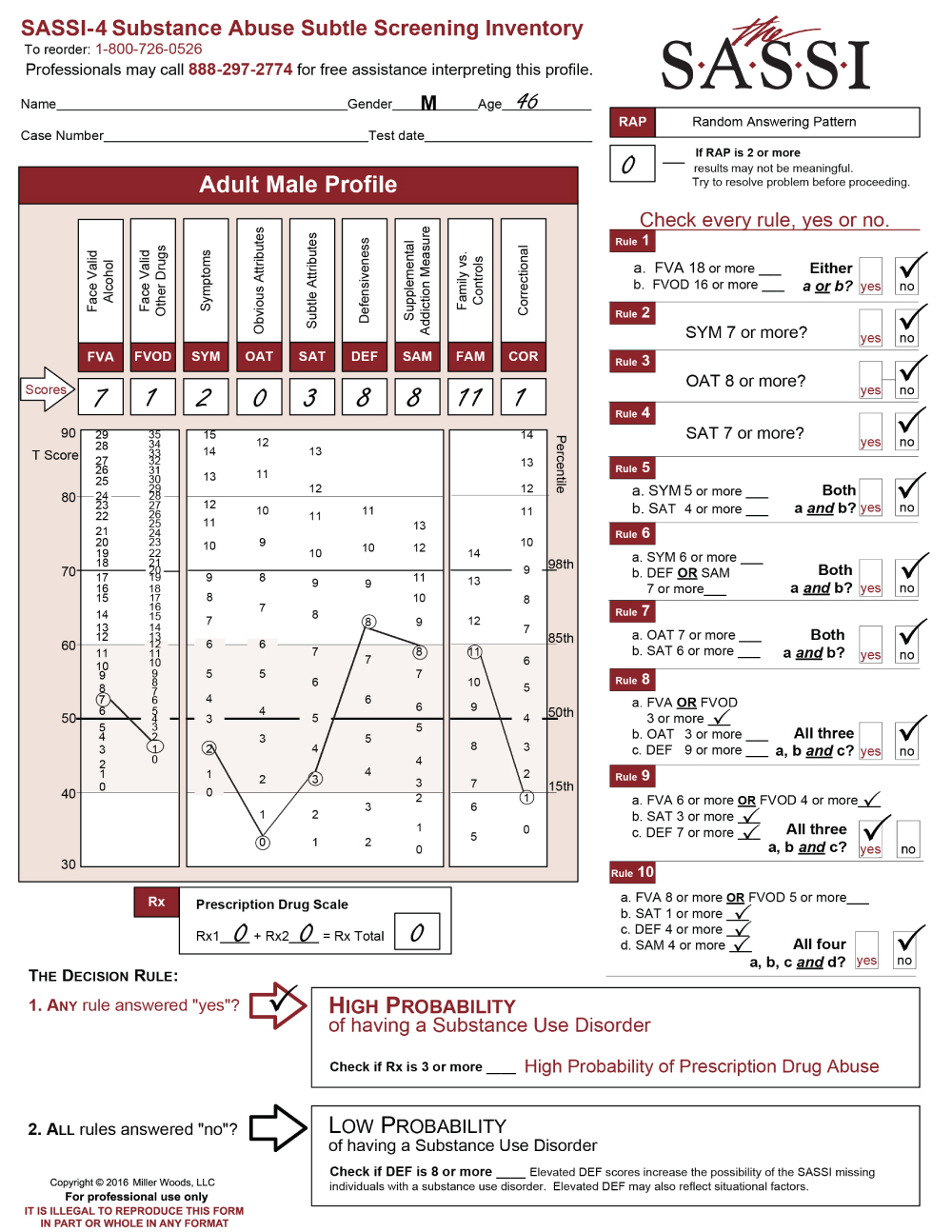
As you can see, he meets Decision Rule # 9. Looking at the graph, some scales and numbers stand out. On his face valid scales, including SYM, his numbers were within the norm, between the 15th and 85th percentile. His OAT score is extremely low which indicates he has a hard time acknowledging personal limitations or shortcomings and may have difficulty in groups. The other significant score is the DEF score of 8. In spite of the elevated DEF score, he did meet one rule. The SAM is almost at the 85th percentile so, in my mind, I might be more inclined to say he was defensive about his substance use and perhaps minimizing on the face valid scales. This hypothesis would depend on the rest of the assessment with any additional information. However, he was given the SASSI to complete within a packet of materials, and it is very unclear what instructions he was given, if any, on how to complete the SASSI.
Let’s look at the results of the 2nd administration given just two weeks later in the office of the counselor who was evaluating him after meeting and talking with the counselor.

In this profile, the client meets multiple decision rules including numbers 3, 4, 5, 6, 7 and 10. All it takes is one rule to meet high probability and more than one does not mean a more severe substance use disorder. Diagnosis and severity are based on the DSM-5 criteria. It is evident his raw scores have changed to impact the decision rule results.
There is a significant change in his Face Valid Scales with an FVA of 11 and an FVOD of 14. His SYM score of 6 also shows elevation. OAT has changed from a 0 to a 9. He is now indicating a willingness to acknowledge shortcomings and limitations. In addition, he probably can identify with other substance abusers so a referral to a group treatment program can be considered.
The significant drop in the DEF score from an 8 to a 5 is nice to see. The client met with the counselor who was able to establish rapport by making the client more comfortable and explaining what the SASSI is and how it will be used in the context of the assessment. The low FAM score reflects the client’s internal state of mind. He is probably very concerned about what is going on within himself and not so concerned about others.
The final interesting scale change is the COR score and probably more representative of the client’s self- assessment at this point. Perhaps he is more able to identify impulsive or anger management issues, risk-taking behaviors, low frustration issues, or poor social skills. It gives the counselor some insight on what to explore, regarding behaviors which are impacting the client’s choices.
The most important difference in these two profiles was how the SASSI was presented to the client. Context, and establishing rapport can produce a more useful SASSI by obtaining a depth of clinical information. As an aside, we were not informed on why the SASSI was administered twice within a two-week time frame. We do not usually recommend doing so. It may have been the counselor was unaware of the first SASSI administration until receiving the completed materials from probation.
We hope you find this useful information regarding clinical issues. As always, the Clinical Helpline at 888-297-2774 is open to serve you Monday through Friday, 9 am to 5 pm (EST).
SASSI Identifies Rx Abuse (with video)
‘Reggie’ is a 37-year-old married man. He and his wife have two children. He works as a warehouse worker where he was recently injured in a shipping dock accident. He recently returned to work after being on worker’s comp for several months during which time he was prescribed opioids for his pain. He was sent to his employer’s EAP provider for evaluation after returning to work and struggling with coping with the continued pain and poor job performance.
Reggie T’s responses illustrate another profile often seen in people who acknowledge that they use drugs excessively and that it negatively impacts on their functioning and relationships.
Given Reggie’s high level of drug use and consequences, you might consider a more comprehensive evaluation to determine whether he may need supervised detoxification or other intensive intervention.
You may find Reggie ready to acknowledge that he uses drugs frequently and that he may also drink too much. However, he may not see that his behavior varies dramatically from others who don’t have a substance use disorder. Feedback on where his scores fall on the profile sheet may help him see that his behaviors are not typical. It may be useful to know that Reggie’s wife is currently in treatment for drug and alcohol abuse due to a DUI. Their mutual abuse of substances may help promote their beliefs that their substance use is normal. Examining the items that Reggie endorsed on the FVA, FVOD, SYM and Rx scales may provide useful insight into his motivations for using and help him see the consequences that result from his use.
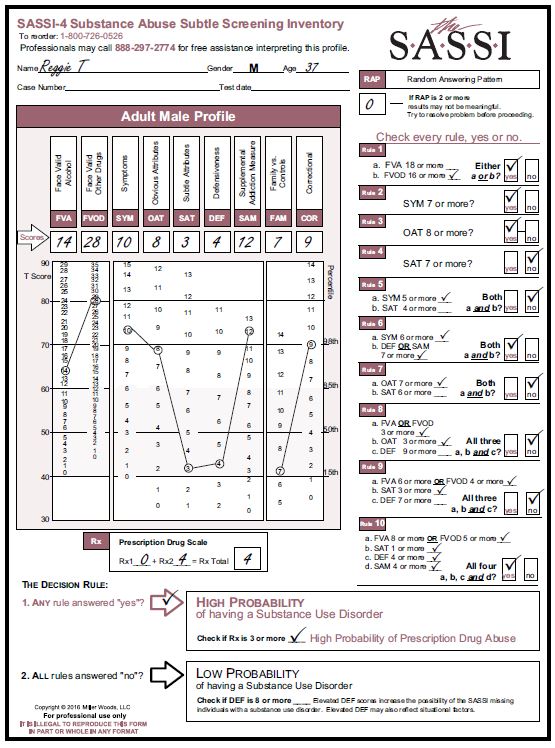
In this first video watch Reggie’s initial EAP visit in which he was asked to take the SASSI.
This second video is the follow-up session where he discusses his SASSI results with the EAP provider.
A SASSI-4 Profile Analysis: Reading Aloud the Questionnaire and Interpretation of Low Scores
We regularly get inquiries about the acceptability of reading the questionnaire to a client who may have difficulty with their reading skills. We discourage the evaluator from reading the questionnaire to the client for a variety of reasons, but the primary one concerns the validity of the results. No matter how careful the reader might be, the tone of voice or emphasis on a particular part of the question may lead the client in one direction or another. Or the client may interrupt with a question regarding the meaning of a word or intention of a particular question. This is why we offer a professionally read audio CD of the SASSI-4, Adolescent SASSI-A3 and Spanish SASSI paper and pencil versions for clients who have reading difficulties. We hope in the future to be able to offer this for the online platform as well. Please contact our customer service department for ordering information.
Another frequent question is related to the clinical interpretations of the “low” scores on the profiles. These mostly relate to the subtle scales which include the OAT, SAT, DEF and SAM scales. Most callers know what a low DEF indicates. And SAM has no clinical interpretation.
So what about those low OAT and SAT scales? What does “low’ mean? A low score is anything below the 15th percentile on the graph. In the example to the right, the caller indicated that she was doing an assessment on a health care professional who had been arrested for her one and only DWI the previous year, had completed her alcohol education class and needed this evaluation as a final step for probation. She was not in trouble in her job and in fact, highly regarded in her profession. Given the client was at the end of her requirements, the evaluator was somewhat concerned with the results and what it meant. The instructions were given to answer the FVA/FVOD side for the last twelve months. Her RAP is zero. Her Prescription Drug Scale is zero. She has ‘no’ on all the rules so came up with a Low Probability of having a Substance Use Disorder. However, her DEF of 9 is highly elevated. Elevated DEF scores increase the possibility of the SASSI missing individuals with a substance use disorder. Elevated DEF may also reflect situational factors. Note that the SAM is within the norm so it is probably more likely that her DEF is situational given the context. She also has an OAT score of ‘O’ and a SAT score of ‘2’. Both are below the 15th percentile. A low OAT indicates someone has difficulty acknowledging personal limitations or shortcomings. A low SAT indicates someone who might have a ‘chip’ on her shoulder, a hypersensitivity to others or feelings of rejection.

So even though this client is nearing the completion of her probation requirements, we still get a picture of someone who is highly guarded (DEF), has a hard time acknowledging shortcomings (OAT) and may continue to exhibit resentment (SAT) for the situation she is in. Perhaps this is due to her profession, or perhaps it is her personality. What the results give the evaluator is clinical direction on how to approach the client to help reduce her defensiveness and give her permission to open up. Affirming how demanding her job is and how on top of things she must be could be a pathway to discussing her feelings of shame related to the DWI and how it might be affecting her self-esteem. Could she be minimizing her use of alcohol and drugs? Perhaps, but as we strongly express, the SASSI is only one part of a clinician’s assessment. Hopefully, with the input of all the information you have, the clinician can evaluate the results which fit the context for this client.
A Review of a SASSI-4
The SASSI-4 I am reviewing is interesting for what it is not.
The client was instructed to complete the FVA/FVOD for the last 12 months.
The client is a 34 year old male with a history of drug and alcohol use. He reports that two and a half years ago he successfully completed treatment. He stopped doing drugs but continues to consume alcohol. He was being evaluated by the order of the court for an “altercation with his ex-spouse”. He does meet multiple rules and comes up with a high probability of a substance use disorder. Remember the number of Rules met does not mean a more significant disorder. The diagnosis is based on the DSM-5 with the designation of mild, moderate or severe based on the number of symptoms met.
As seen on the profile sheet, he has a number of elevated scales including the FVA, SYM, OAT, SAT and COR. What is interesting, is that his DEF is not elevated and is below average staying within the norm. For domestic violence cases, this is fairly unusual. Often we see an elevated DEF above the 85th percentile. The FVA and SYM scores indicate an openness and acknowledgment of his use as well as symptoms and consequences. The elevated SYM also indicates he is either hanging out with or from a family of heavy users. In this case, he disclosed his family has a history of alcohol abuse.
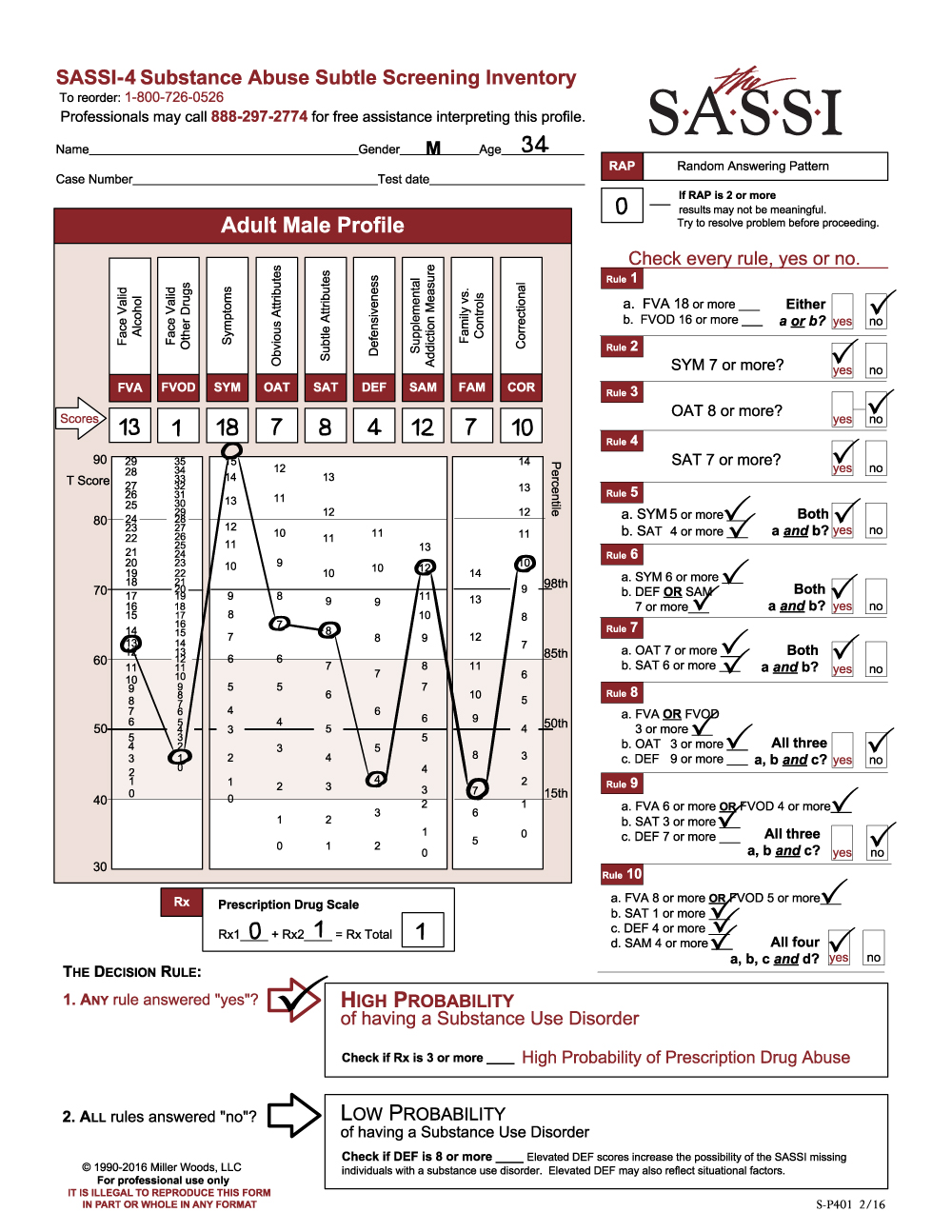
The elevated OAT score indicates that he can probably identify with other substance users and those behaviors we often see with substance abusers i.e. impatience, resentment, self-pity and impulsiveness. On the other hand, his elevated SAT indicates a lack of awareness or insight or simple denial of the impact alcohol is having on him. He readily acknowledges his past drug issues but has put alcohol in a separate category. His final elevated scale is COR. Regardless of any past or present legal issues, we encourage evaluating for those behaviors that impact the ability to make good choices. These behaviors can range from poor social skills, low frustration tolerance, risk-taking behaviors to impulse control or anger management issues.
Utilizing the results: The evaluation started out as a domestic violence case but transitioned to also include substance use. The fact that the client was open about his alcohol use, not defensive and has a successful treatment history suggests he may be willing to take a look at his alcohol use and its impact on his behavior. His elevated OAT score does indicate treatment readiness and he is not going to feel out of place in a group setting. The emphasis will be to help him connect the dots between his alcohol use and any impulsive behaviors. This does not take the place of any recommended intervention for anger management issues he may have. The administrator has a good opportunity to facilitate the client to continue the work needed on his recovery and deal with all his issues.
We hope this is helpful for you in your work with your clients. As usual, the free clinical helpline is open for your questions M-F, 11-5, (EST). Don’t hesitate to call us whether you are new to the SASSI or an old hand.
The “Unaware” Client
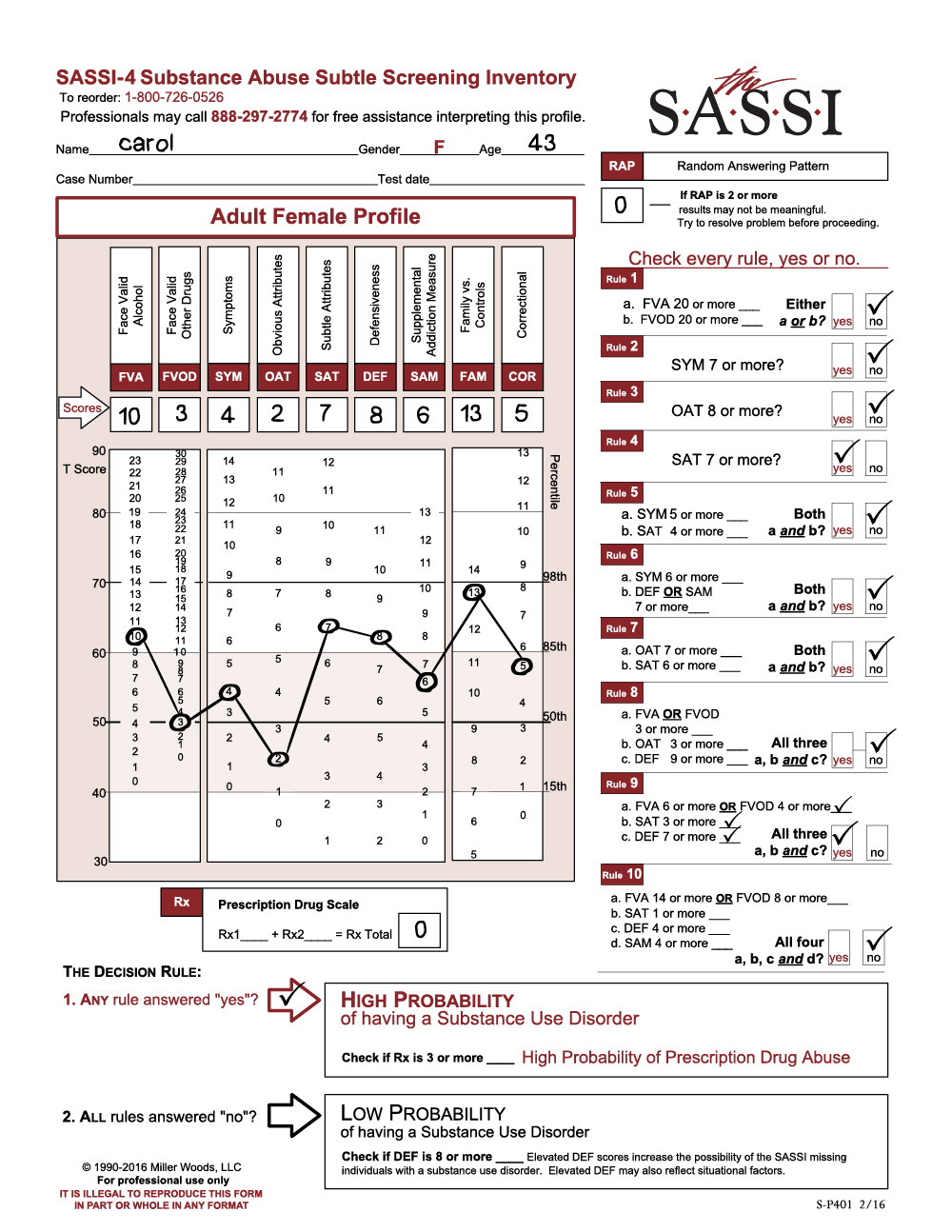
The client, Carol, is a 43-year-old married female, a successful business woman and mother of two children. She recently was arrested and charged with her first DWI after leaving a business dinner with sales associates. This is the first significant consequence related to her drinking. She claims that she does not have a drinking problem; however, she characterizes her mother as an alcoholic.
As we take a look at her scores, first notice that Carol appears to have responded in a meaningful way to the items on the SASSI-4 (RAP=0). However, there is some evidence that she may have approached the assessment process in a defensive manner (DEF=8). Despite her apparent defensiveness, the SASSI results indicate that she has a high probability of having a moderate to severe substance use disorder (SAT=7 leading to a positive on decision rule 4).
Given the elevations on the SAT and DEF, we get the sense that Carol may have some difficulty recognizing (high SAT) and acknowledging (high DEF) the nature of her substance-related problems. Yes, it is true that she reports significant problematic use of alcohol (FVA=10). However, it will be important to review with her the content of her responses on the face valid alcohol scale in order to gain some understanding of how she views these consequences. Our experience with the SASSI and our knowledge of the nature of the addictive process suggest to us that individuals who have elevated SAT and DEF scores (especially when OAT is average or below, as is the case here) often have difficulty seeing the manner in which their drinking has pervaded other areas of functioning. Therefore, it is reasonable to expect that much of what she has reported on the FVA may be flavored with a theme of, “I’m so embarrassed about these things, but thank God I don’t have a problem.”
Carol’s FAM score is elevated (13), suggesting that her responses are similar to individuals who have a history of being in relationships with others who are substance dependent. This is often related to a tendency to focus on others and a need to try to control the external environment. Elevated scores on SAT, DEF, and FAM suggest that Carol is likely to have an exceptionally strong tendency to deflect attention away from any suggestion that it is important for her to make significant changes in her life. Carol’s lack of awareness and insight may not only be rooted in her own addictive disorder but may also be fostered by a long history of trying to cover up for her mother and feeling responsible for the family’s welfare.
Despite Carol’s inability to see her substance misuse as a serious problem in her life, the SASSI results clearly indicate that she is likely to meet the diagnostic criteria of a substance use disorder. Therefore, effective treatment planning will need to include some form of addictions therapy, most likely at the outpatient level of care. The therapeutic challenge for the treatment provider will be to establish a working relationship with Carol that is conducive to helping her explore the substance abuse issues in her life. This usually means starting where the client is and moving her in a direction of increased awareness and insight regarding the nature of her own substance use problems and the changes that can help her begin a process of healing and recovery.
Carol comes to the treatment setting with recognition of her mother’s alcoholism. She has a desire to disclose information about her life growing up with an alcoholic mom. This gives the treatment provider a naturally occurring place to begin. As Carol bonds with her therapist in the work of resolving the pain of her childhood, the therapist can help her examine the significance of her own alcohol usage. The therapy can be augmented by support groups in which Carol can learn from the experiences of others who come from similar home environments and from other people who have had to struggle with the reality of their own addiction problems. Ongoing assessment will be helpful during this process to monitor her progress and make adjustments in the treatment plan as necessary. For example, if she is unable to refrain from using, has additional alcohol-related social or legal consequences, or becomes non-compliant in the treatment process, it may be necessary to move to a more intensive level of care.
The emotional impact of growing up in an environment that is dominated by the pain and shame of addiction takes many forms and can exert its influence throughout a person’s life. Carol’s DWI can be a gift. With appropriate intervention, Carol can begin a process of self-examination and growth that will lead to a freer, richer life.
Criminal Justice Publication Accepted
Hello friends and colleagues,
We hope you and your families are all doing well. We wanted to call your attention to our very latest peer reviewed publication, released earlier this month. The title is: Criminal Justice Alcohol and Drug Screening in Practice: Using the Substance Abuse Subtle Screening Inventory to Identify Substance Use Disorder in Offenders.
Now in its fourth iteration (SASSI-4), this article discusses the SASSI screening tools’ utility with criminal offenders and reviews a case study of a young male’s clinical evaluation while incarcerated. While SUD is not the only contributing factor to criminality, it significantly increases the likelihood of legal infraction and violations, placing these individuals at a higher risk of re-offending. Thus, identifying SUD as early as possible in the clinical relationship helps provide tailored treatment to those who need it, while simultaneously reducing the risk of future legal difficulties.
For this case study, we reviewed the SASSI-4 screening results of a 24-year-old male. The case presents an excellent example of the value of early identification of substance use disorder and potential problems in criminal justice settings.
We hope you enjoy the article, and as always, we look forward to your submissions and comments.
Client’s High SAT Score Indicates Lack of Awareness
Bob is a 43-year old male who was referred by his attorney for a substance evaluation following a traffic fatality in which he was driving under the influence. Bob seems to have understood the items and responded in a meaningful way (RAP = 0). There is no significant evidence that Bob was defensive (DEF = 7).
The most salient feature of the profile is the significantly elevated SAT score, which is a key feature in both decision rules that lead to a test positive on the SASSI (Decision Rules 4, 5, 6, and 7). His responses were highly similar to substance dependent individuals regardless of their ability or willingness to report symptoms relevant to substance misuse. Given the lack of evidence of defensive responding, it’s likely that Bob falls in the category of those who are unaware of the full impact of substance use problems in their lives.
Individuals with this configuration of scores are often willing to acknowledge some behavioral problems related to their substance use. Bob demonstrates this by acknowledging significant current and/or past alcohol (FVA=14) and drug (FVOD=12) use. His pattern of responding also indicates some awareness of behavioral problems that are commonly associated with individuals with substance use disorders: low frustration tolerance, self-centeredness, grandiosity, etc. (OAT=7). However, given the elevated SAT, he will most likely not be able to make any connection between his acknowledged use and behavioral problems and their impact on other areas of his life.
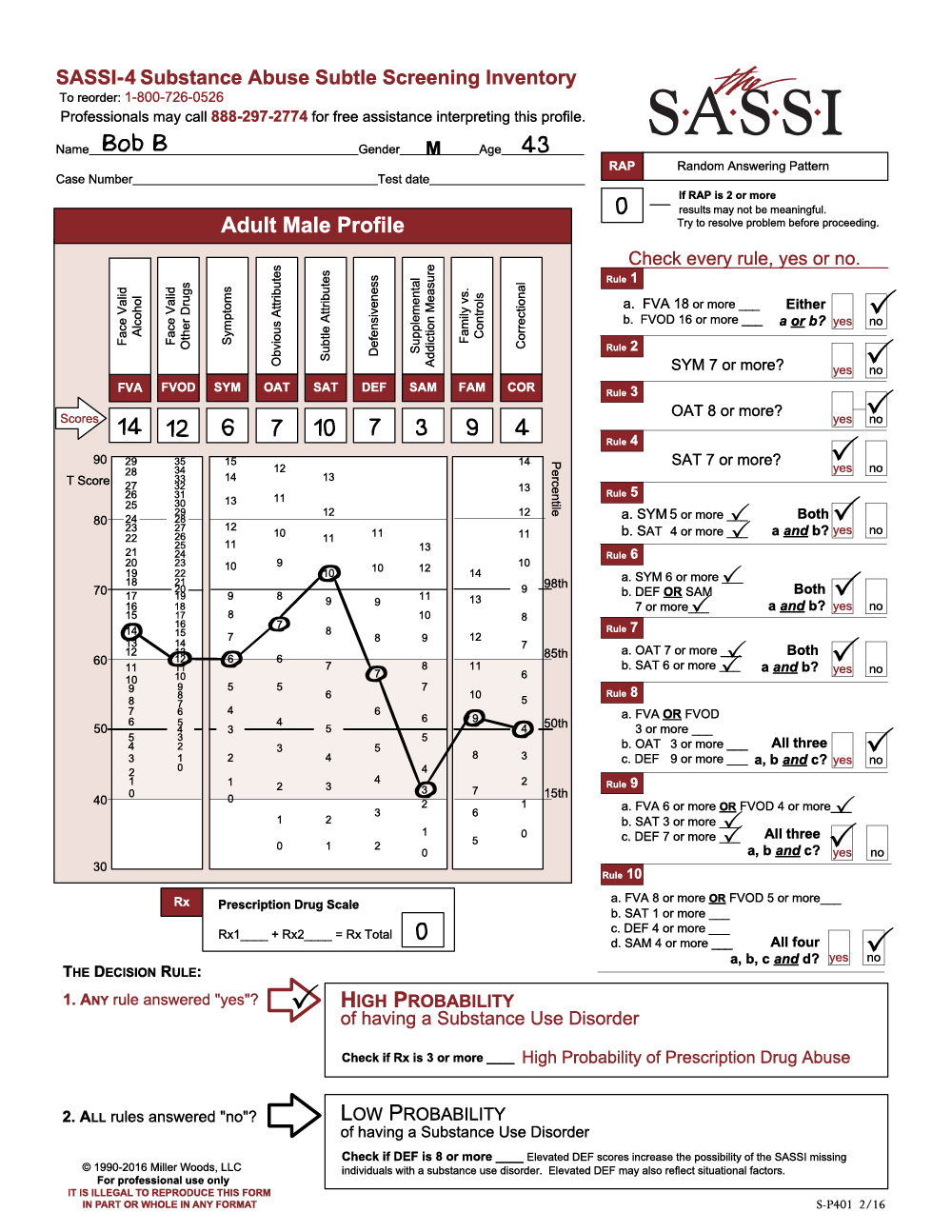
He also responds in a fashion similar to individuals who live in an environment dominated by substance abuse (SYM=6). Although the SYM is not extremely elevated, it does tend to support the notion that Mr. B. may view his substance use as normal. Further content analysis may reveal additional factors about his life circumstances that might be important to consider in treatment planning.
Bob may be relatively well presented. He may also appear to be emotionally detached while maintaining a sense of pragmatism regarding his situation. Relatively poor insight and self-awareness are commonly present in these types of profiles. It’s not that Bob refuses to understand or is intentionally resistant; he literally doesn’t grasp that his substance use may be a problem that requires further exploration. In his mind, external factors or stressors may be to blame for his current predicament. The possibility that this tragic incident may be directly related to a substance use problem would be quite difficult for Bob to understand at this time.
SASSI Results Highlight Excessive Drug Use Including Rx Abuse
Angela T. illustrates a profile often seen in people who acknowledge that they use drugs excessively and have come to rely on them as a coping resource.
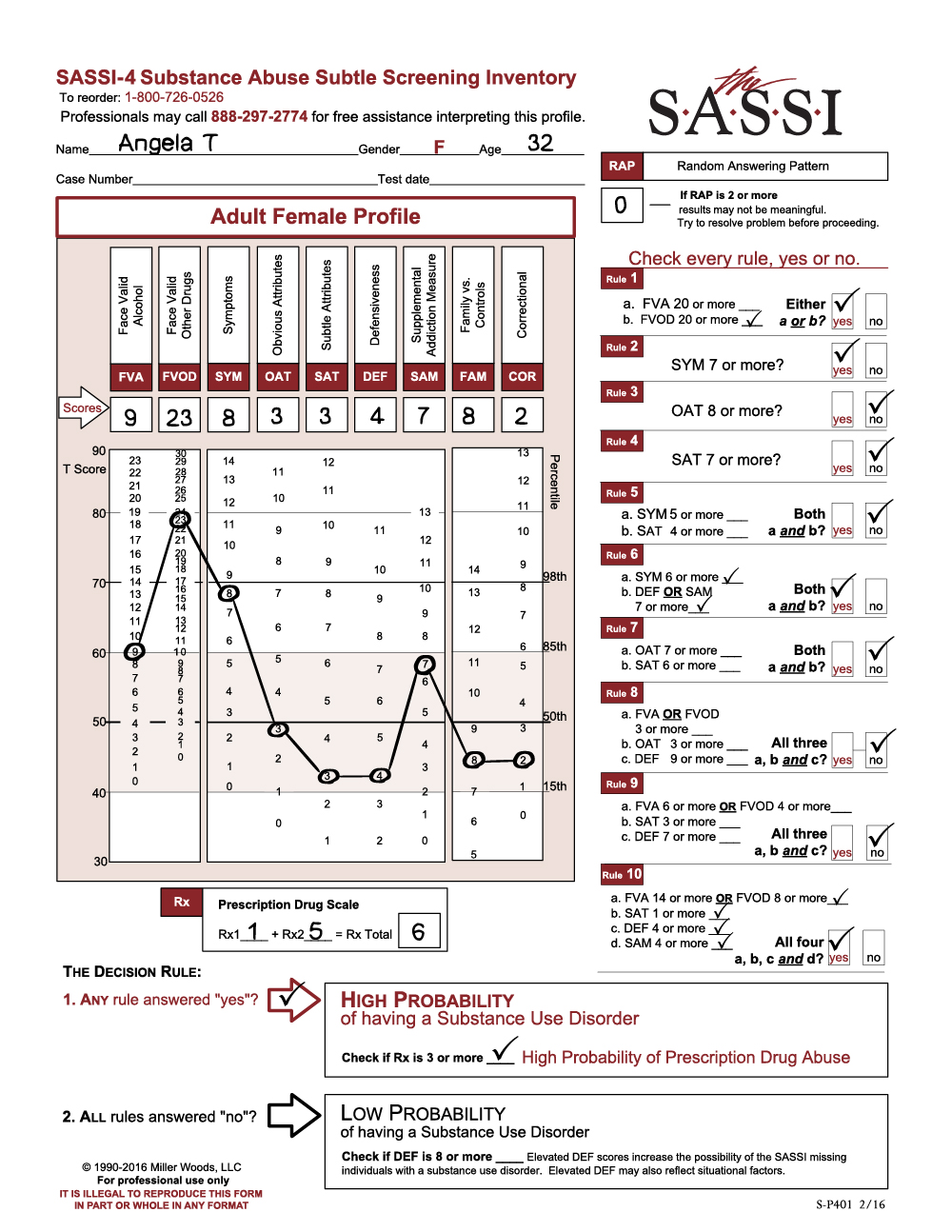
Angela’s scores on the SASSI-4 meet the criteria for classifying her as having a high probability of a substance use disorder. Angela’s score on the Rx scale also indicates a high probability of prescription drug abuse.
Reviewing her scale scores reveals openness in disclosing her use of drugs and alcohol. On FVOD and SYM, Angela acknowledges extensive use of drugs and many negative consequences and symptoms of abuse. Examining her answers to specific items on these scales may help you counsel Angela, and may suggest good starting points for a more detailed history of her use of alcohol, drugs and prescription medications.
On SYM Angela acknowledges serious substance misuse that she acknowledges resulted in making her problems worse, increased tolerance, excessive use, and wishing she could cut down her use of substances. Her OAT score is in the average range, which can indicate that Angela does not necessarily align herself with those characteristics associated with substance abusers and she may not see herself as a ‘drug addict.’
With her Prescription Drug scale (Rx) score of 6, it is useful to look at those individual items as well.
Angela’s moderate DEF score suggests she can be open and realistic in acknowledging her difficulties and substance misuse. The rest of her scores fall within the normal range, between the 15th and 85th percentiles.
Given Angela’s high level of drug use and consequences, you might consider a more comprehensive evaluation to determine whether she can maintain sobriety and function well enough to benefit from a treatment program. She may need supervised detoxification or other intensive intervention.
You may find Angela able to acknowledge that she uses drugs frequently and perhaps that she drinks to excess. However, she may not see that her behavior varies dramatically from others who don’t have a substance use disorder. Feedback on where her scores fall on the profile sheet may help her see that her behaviors are not typical. Examining the items that Angela endorsed on the FVA, FVOD, SYM, and Rx scales may provide useful insight into her motivations for using and help her see the consequences that result from her use. Angela may need your help to acknowledge her pain and to recognize that there are alternatives to her current lifestyle.
The SASSI-4 screens for Substance Use Disorder (SUD) along the full DSM-5 continuum of severity: mild, moderate, and severe. A brief scale, Prescription Drug (Rx), was added to accurately identify individuals likely to be abusing prescription medications. Read a full sample assessment report on Angela T. in the SASSI-4 User Guide & Manual.